
Introduction
In the ever-evolving world of financial markets, traders are constantly searching for strategies that offer consistency, automation and reduced emotional stress. One such method that has gained popularity among both beginners and experienced traders is the Grid Trading Strategy.
Grid trading is particularly attractive because it does not rely heavily on predicting market direction. Instead, it capitalizes on market volatility by placing a series of buy and sell orders at predetermined intervals. When executed properly, this strategy can generate consistent profits in ranging markets and even perform reasonably well in trending conditions with proper risk management.
In this comprehensive guide, we will explore everything you need to know about grid trading—from its core principles to advanced optimization techniques.
What is Grid Trading?
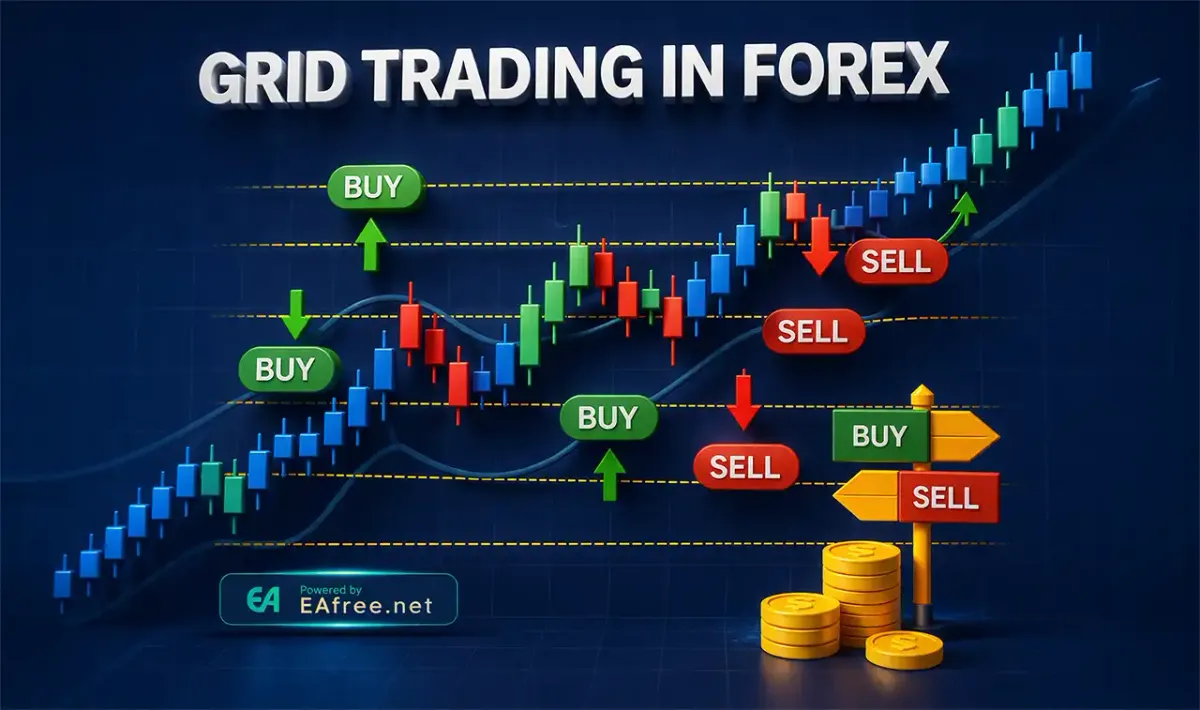
Grid trading is a systematic trading strategy that involves placing multiple buy and sell orders at fixed price intervals above and below a predefined base price.
Imagine creating a “grid” on the price chart:
- Buy orders are placed at lower levels
- Sell orders are placed at higher levels
As the market moves up and down, trades are automatically triggered, allowing traders to profit from price fluctuations without needing to predict exact market direction.
//Key Characteristics:
- Works best in sideways (ranging) markets
- Can be automated using trading bots
- Requires careful capital allocation
- Profits from volatility rather than trend direction
How Grid Trading Works
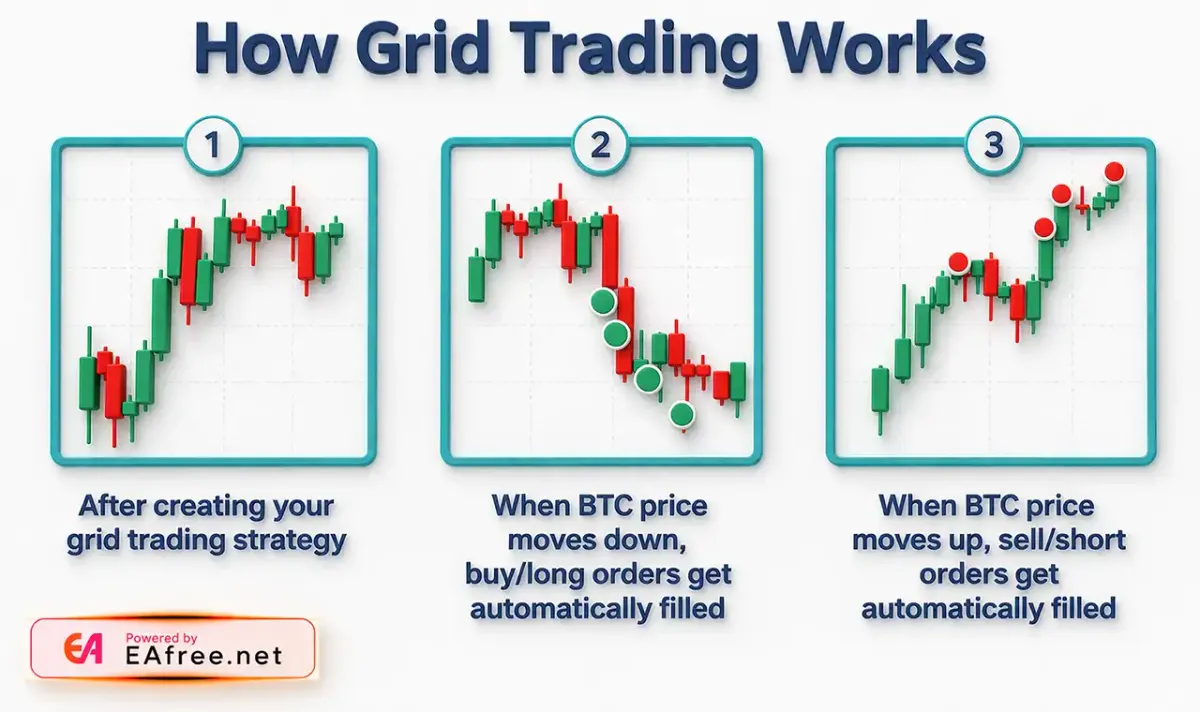
At its core, grid trading divides a price range into multiple levels. Each level represents a trading opportunity.
//Example:
Suppose:
- Current price = $100
- Grid interval = $5
- Range = $80 to $120
You might place:
- Buy orders at: $95, $90, $85, $80
- Sell orders at: $105, $110, $115, $120
When the price moves:
- Down → buy orders are filled
- Up → sell orders are executed
Each completed cycle (buy low → sell high) locks in profit.
Types of Grid Trading Strategies
//1. Arithmetic Grid
In this model, price intervals are evenly spaced.
Example:
- $100, $105, $110, $115...
Best for:
- Stable markets
- Predictable price ranges
//2. Geometric Grid
Here, price levels are spaced by percentages rather than fixed amounts.
Example:
- $100 → $105 → $110.25 → $115.76...
Best for:
- Volatile markets
- Assets with exponential growth patterns
//3. Neutral Grid Strategy
This approach does not assume market direction.
- Orders are placed both above and below current price
- Profits from oscillations
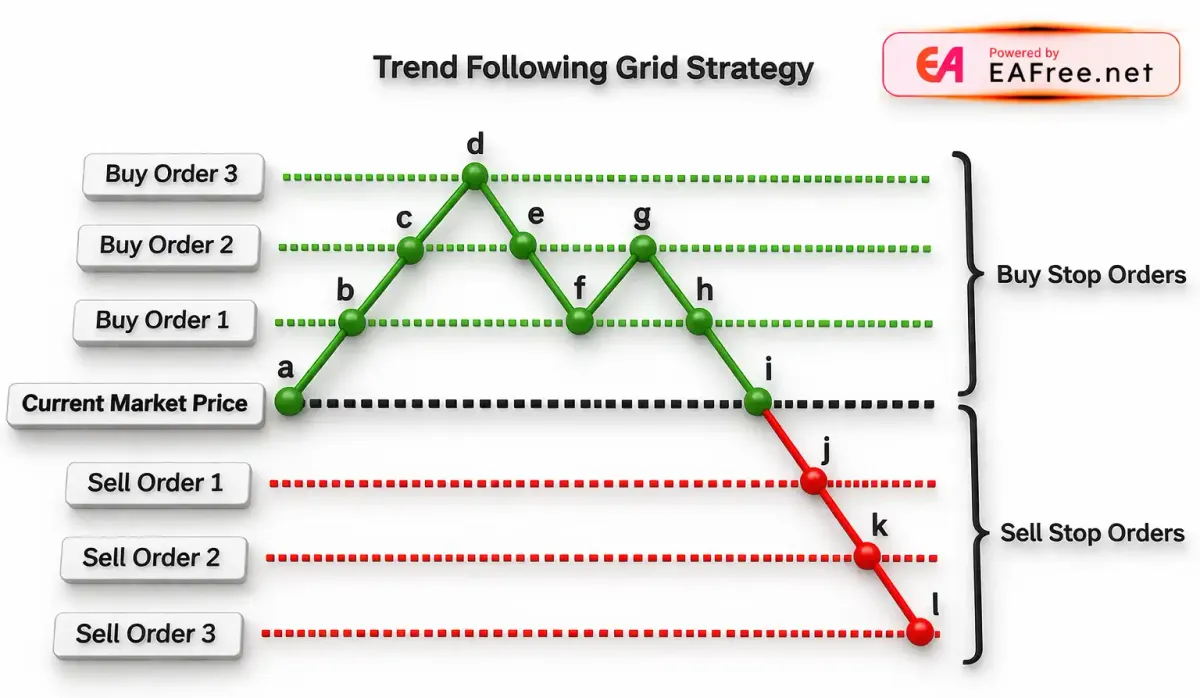
//4. Trend-Following Grid
This variation adjusts grid placement based on market direction.
- More buy orders in uptrend
- More sell orders in downtrend
Advantages of Grid Trading
//1. Emotion-Free Trading
One of the biggest advantages is automation. Once the grid is set:
- No need for constant monitoring
- Reduced emotional decision-making
//2. Profits in Sideways Markets
Unlike many strategies that rely on trends, grid trading thrives in ranging conditions.
//3. Easy to Automate
Grid trading is ideal for:
- Trading bots
- Algorithmic trading systems
//4. Scalable Strategy
You can:
- Increase grid levels
- Adjust capital allocation
- Expand trading range
Risks of Grid Trading
While attractive, grid trading is not risk-free.
//1. Trending Market Risk
In strong trends:
- Price may move continuously in one direction
- Accumulated positions can lead to large drawdowns
//2. Capital Requirements
More grid levels = more capital needed.
Without sufficient funds:
- You risk liquidation or margin calls
//3. Poor Range Selection
If your grid range is too narrow or too wide:
- Trades may not trigger
- Or losses may accumulate
//4. Over-Optimization
Trying to fine-tune too many parameters can:
- Reduce robustness
- Increase risk of failure in real markets
How to Set Up a Grid Trading Strategy
//Step 1: Choose the Right Market
Ideal markets:
- Forex pairs (EUR/USD, USD/JPY)
- Cryptocurrencies (BTC, ETH)
- Commodities with stable ranges
//Step 2: Define the Range
Set:
- Upper boundary
- Lower boundary
Tip:
Use historical support and resistance levels.
//Step 3: Determine Grid Size
Decide:
- Number of grid levels
- Distance between each level
Smaller grids:
- More trades
- Smaller profits per trade
Larger grids:
- Fewer trades
- Larger profit per trade
//Step 4: Allocate Capital
Divide your capital evenly across grid levels.
Example:
- Total capital: $1,000
- 10 grids → $100 per trade
//Step 5: Set Risk Controls
Always include:
- Stop-loss limits
- Maximum drawdown threshold
- Emergency exit plan
Grid Trading vs Other Strategies
| Strategy | Market Type | Complexity | Risk Level |
|---|---|---|---|
| Grid Trading | Ranging | Medium | Medium |
| Trend Following | Trending | Medium | Medium |
| Scalping | High volatility | High | High |
| Swing Trading | Mixed | Medium | Medium |
Grid trading stands out because it:
- Does not require precise entry timing
- Can be automated easily
Best Practices for Consistent Profits
//1. Combine with Indicators
Use tools like:
- RSI (to detect overbought/oversold)
- Moving Averages (to identify trends)
//2. Avoid Strong Trends
Before deploying a grid:
- Check market conditions
- Avoid major news events
//3. Use Dynamic Grids
Instead of fixed levels:
- Adjust grid based on volatility
- Adapt to market changes
//4. Backtest Your Strategy
Always test on:
- Historical data
- Demo accounts
//5. Diversify
Don’t rely on a single asset:
- Spread across multiple pairs or coins
Grid Trading in Cryptocurrency Markets
Grid trading has become especially popular in crypto due to:
- High volatility
- 24/7 trading
- Frequent price oscillations
Many exchanges offer built-in grid trading bots, allowing traders to:
- Automate strategies easily
- Customize parameters quickly
However, crypto markets can trend strongly, so risk management is crucial.
Common Mistakes to Avoid
//1. Ignoring Market Conditions
Grid trading in a strong trend can be dangerous.
//2. Using Too Many Grids
Overcomplicating your setup can:
- Reduce efficiency
- Increase fees
//3. Lack of Stop-Loss
Never run a grid without a safety mechanism.
//4. Over-Leveraging
Using leverage amplifies risk significantly.
Advanced Grid Trading Techniques
//1. Hedged Grid Strategy
This involves:
- Opening both long and short positions
- Balancing risk exposure
//2. AI-Optimized Grids
Modern traders use:
- Machine learning models
- Adaptive algorithms
//3. Volatility-Based Grids
Adjust grid spacing based on:
- Market volatility indicators
- Average True Range (ATR)
Is Grid Trading Profitable?
The answer depends on:
- Market conditions
- Strategy setup
- Risk management
Grid trading can be highly profitable when:
- Markets are ranging
- Parameters are well-optimized
- Risks are controlled
However, it is not a “set and forget” strategy forever—it requires periodic adjustments.
Conclusion
Grid trading is a powerful and versatile strategy that allows traders to profit from market fluctuations without predicting direction. Its structured approach, automation potential, and adaptability make it an excellent choice for both beginners and experienced traders.
However, success with grid trading requires:
- Proper planning.
- Risk management.
- Continuous monitoring and optimization.
If used wisely, grid trading can become a reliable tool for generating consistent profits over time.