
Introduction to Non-Farm Payrolls (NFP)
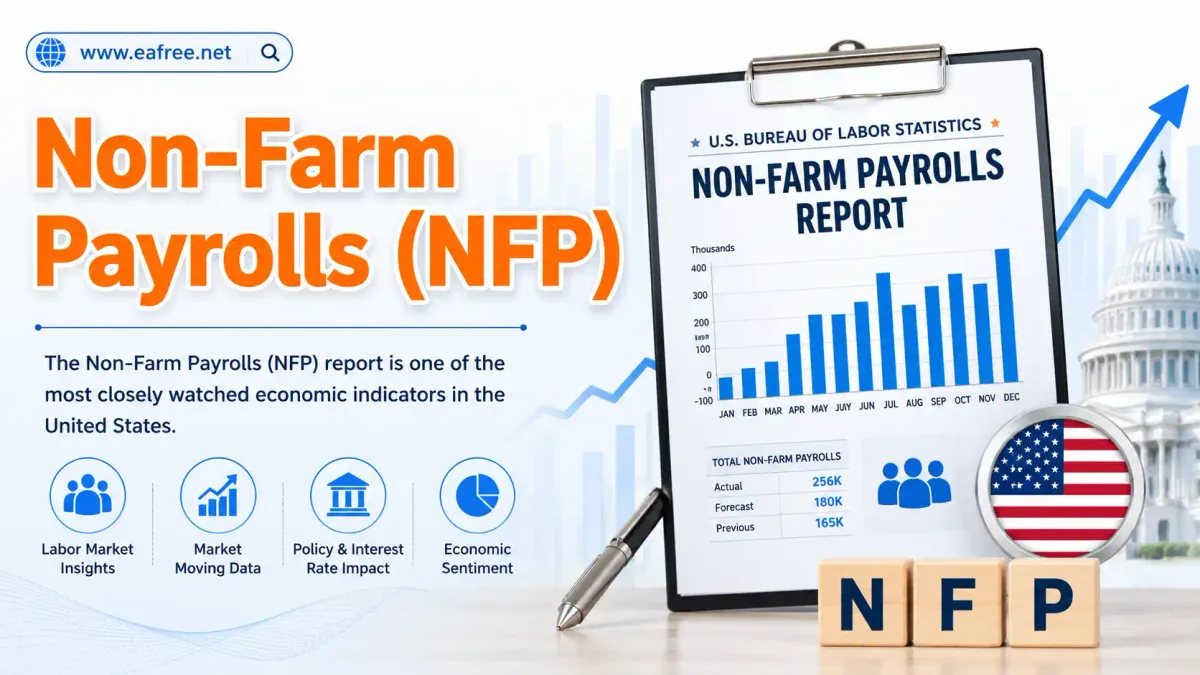
The Non-Farm Payrolls (NFP) report is one of the most closely watched economic indicators in the United States. Released monthly by the U.S. Bureau of Labor Statistics (BLS), the report provides valuable insights into the health of the labor market and the overall economy.
Investors, economists, policymakers, and traders all pay close attention to NFP data because it can significantly influence financial markets, interest rate decisions, and economic sentiment. Whether you are a beginner investor or an experienced trader, understanding the NFP report is essential for making informed financial decisions.
What Is the Non-Farm Payrolls Report?
The Non-Farm Payrolls report measures the number of jobs added or lost in the U.S. economy during the previous month, excluding farm workers, private household employees, nonprofit workers, and government-related categories such as military personnel.
The report is usually released on the first Friday of every month and includes important labor market statistics such as:
- Total non-farm employment change
- Unemployment rate
- Average hourly earnings
- Labor force participation rate
- Average weekly working hours
Because employment is closely tied to consumer spending and economic growth, the NFP report serves as a major indicator of economic performance.
//Sectors Included in NFP
| Included Sectors | Excluded Sectors |
|---|---|
| Manufacturing | Farm workers |
| Construction | Private household employees |
| Healthcare | Nonprofit organizations |
| Retail | Active military |
| Technology | Self-employed individuals |
| Financial services | Certain government workers |
How the NFP Report Is Calculated
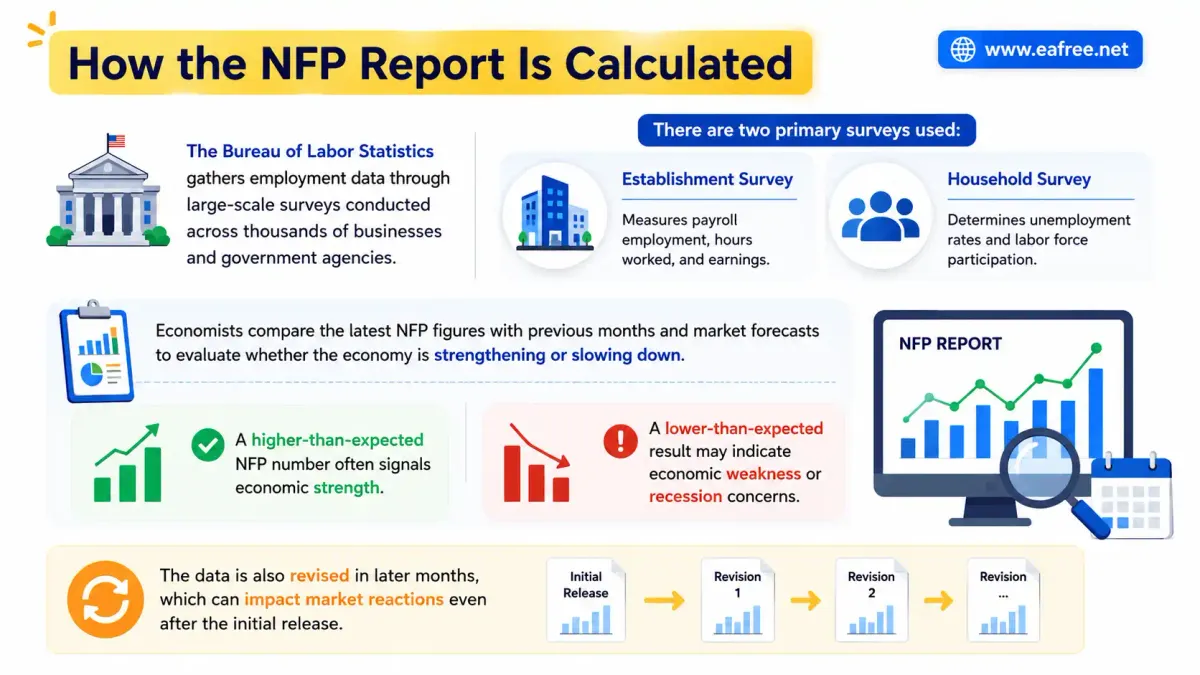
The Bureau of Labor Statistics gathers employment data through large-scale surveys conducted across thousands of businesses and government agencies.
There are two primary surveys used:
- Establishment Survey – Measures payroll employment, hours worked and earnings.
- Household Survey – Determines unemployment rates and labor force participation.
Economists compare the latest NFP figures with previous months and market forecasts to evaluate whether the economy is strengthening or slowing down.
For example:
- A higher-than-expected NFP number often signals economic strength.
- A lower-than-expected result may indicate economic weakness or recession concerns.
The data is also revised in later months, which can impact market reactions even after the initial release.
Why Non-Farm Payrolls Matter for the Economy
The labor market is one of the strongest indicators of economic health. When businesses hire more workers, consumer income generally rises, leading to increased spending and economic expansion.
The NFP report matters because it helps measure:
- Economic growth
- Business confidence
- Consumer demand
- Wage inflation
- Federal Reserve policy direction
Strong job growth often suggests that companies are optimistic about future demand. On the other hand, weak employment growth may indicate slowing economic activity.
//Relationship Between NFP and Interest Rates
The Federal Reserve closely monitors employment data when deciding whether to raise or lower interest rates.
Here is a simplified overview:
| NFP Result | Economic Signal | Possible Fed Action |
|---|---|---|
| Strong job growth | Expanding economy | Raise interest rates |
| Weak job growth | Slowing economy | Lower or pause rates |
| Rising wages | Inflation pressure | Tighten monetary policy |
| Falling employment | Economic weakness | Support economy with lower rates |
Because interest rates affect borrowing costs, mortgages, business investment, and stock valuations, NFP releases can create major market volatility.
How NFP Affects Financial Markets
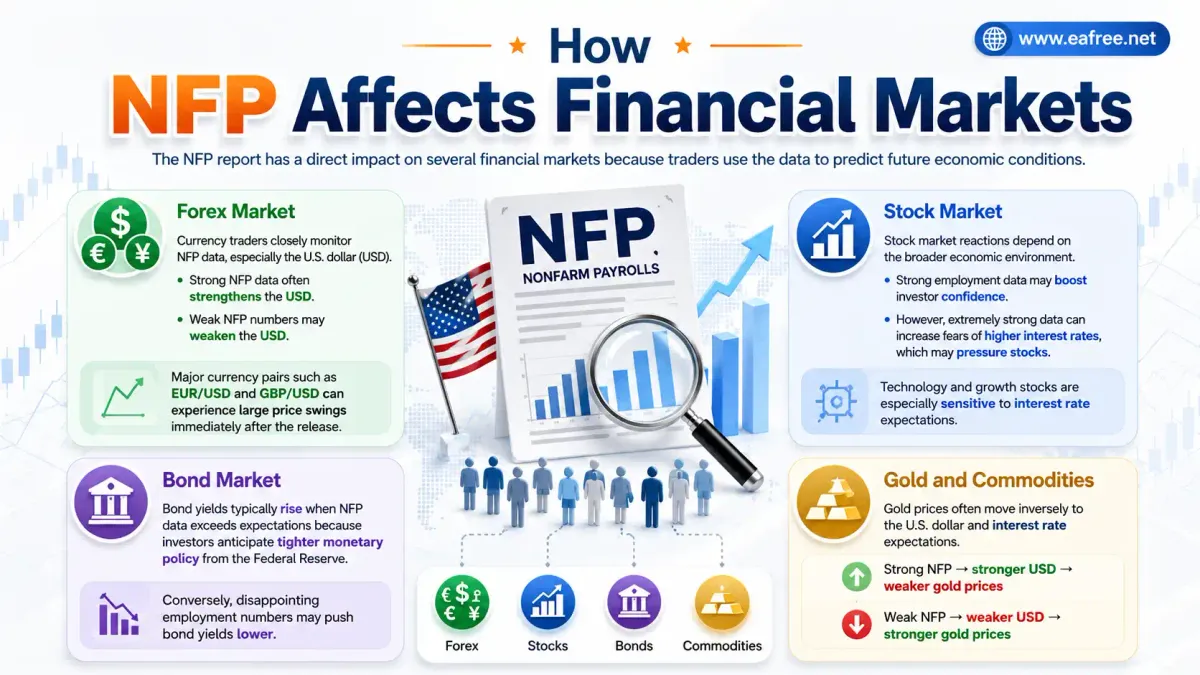
The NFP report has a direct impact on several financial markets because traders use the data to predict future economic conditions.
//Forex Market
Currency traders closely monitor NFP data, especially the U.S. dollar (USD).
- Strong NFP data often strengthens the USD.
- Weak NFP numbers may weaken the USD.
Major currency pairs such as EUR/USD and GBP/USD can experience large price swings immediately after the release.
//Stock Market
Stock market reactions depend on the broader economic environment.
- Strong employment data may boost investor confidence.
- However, extremely strong data can increase fears of higher interest rates, which may pressure stocks.
Technology and growth stocks are especially sensitive to interest rate expectations.
//Bond Market
Bond yields typically rise when NFP data exceeds expectations because investors anticipate tighter monetary policy from the Federal Reserve.
Conversely, disappointing employment numbers may push bond yields lower.
//Gold and Commodities
Gold prices often move inversely to the U.S. dollar and interest rate expectations.
- Strong NFP → stronger USD → weaker gold prices
- Weak NFP → weaker USD → stronger gold prices
Key Components of the NFP Report
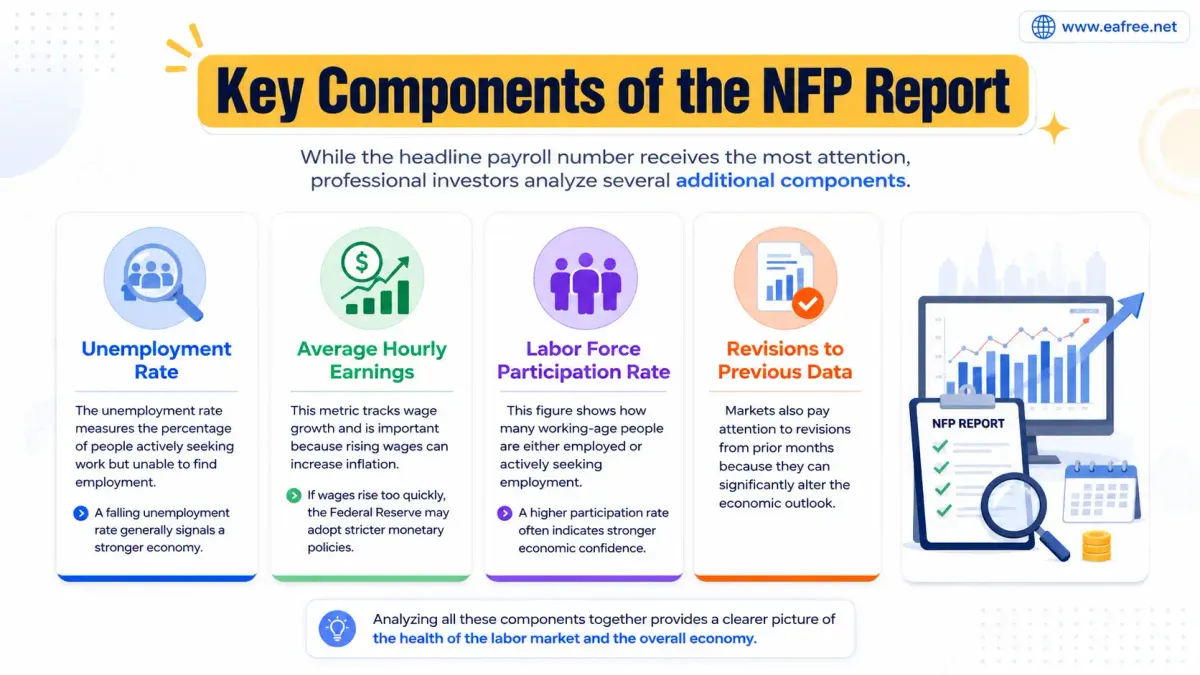
While the headline payroll number receives the most attention, professional investors analyze several additional components.
//Unemployment Rate
The unemployment rate measures the percentage of people actively seeking work but unable to find employment.
A falling unemployment rate generally signals a stronger economy.
//Average Hourly Earnings
This metric tracks wage growth and is important because rising wages can increase inflation.
If wages rise too quickly, the Federal Reserve may adopt stricter monetary policies.
//Labor Force Participation Rate
This figure shows how many working-age people are either employed or actively seeking employment.
A higher participation rate often indicates stronger economic confidence.
//Revisions to Previous Data
Markets also pay attention to revisions from prior months because they can significantly alter the economic outlook.
Recent Trends and What Investors Watch
In recent years, the NFP report has become even more important due to inflation concerns, global economic uncertainty, and changing Federal Reserve policies.
Investors now focus not only on job creation but also on:
- Wage growth trends
- Labor shortages
- Remote work changes
- Inflation pressures
- Recession risks
For example, a strong jobs report combined with rising wages may increase fears that inflation will remain elevated for longer periods.
As a result, traders carefully compare actual NFP numbers against analyst expectations to predict future market direction.
Tips for Traders and Investors During NFP Releases
NFP release days are known for high market volatility. Traders should prepare carefully before entering positions.
//Best Practices During NFP Announcements
| Tip | Explanation |
|---|---|
| Monitor forecasts | Compare expected vs actual data |
| Avoid overleveraging | Volatility can cause rapid losses |
| Watch wage data | Inflation concerns matter greatly |
| Use stop-loss orders | Protect against sudden price swings |
| Wait for confirmation | Initial reactions can reverse quickly |
Long-term investors should avoid making emotional decisions based solely on one monthly report. Instead, they should analyze broader economic trends over time.
Conclusion
The Non-Farm Payrolls report is one of the most influential economic indicators in the world. It provides critical insights into employment trends, economic growth, inflation pressures and potential Federal Reserve actions.
Because the labor market plays a major role in consumer spending and overall economic stability, NFP data heavily influences stocks, forex, bonds and commodities.
Understanding how the NFP report works can help investors, traders, and businesses make smarter financial decisions and better prepare for market volatility.
FAQs
❓ What time is the NFP report released?
The NFP report is usually released on the first Friday of each month at 8:30 AM Eastern Time (ET).
❓ Why does the NFP report move the markets so much?
Because it provides important information about economic growth, inflation, and potential Federal Reserve policy decisions.
❓ What is considered a strong NFP number?
A strong NFP result depends on market expectations, but generally, job growth significantly above forecasts is viewed positively.
❓ Which markets are most affected by NFP data?
Forex, stock indices, bonds, gold, and commodities are highly sensitive to NFP releases.
❓ Can NFP data predict a recession?
Weak or declining payroll growth over several months may signal economic slowdown or recession risks, but it should be analyzed alongside other indicators.