
What Are Order Blocks?
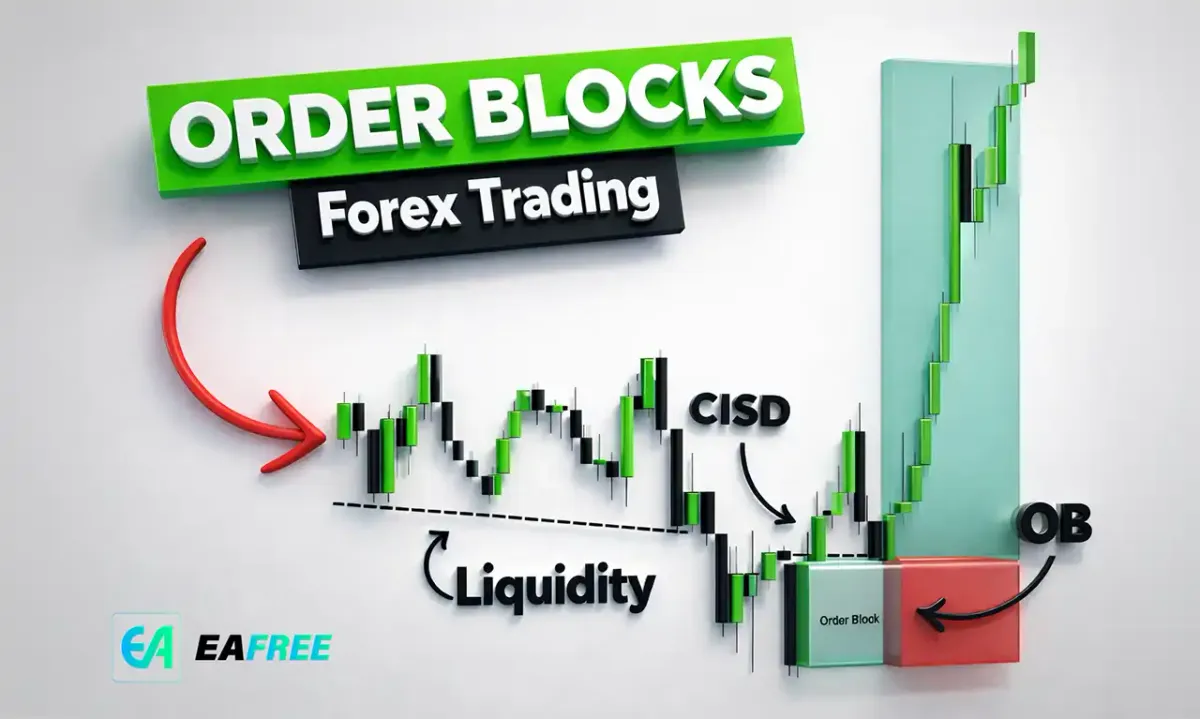
An order block is a specific price area where large institutional traders—such as banks, hedge funds and financial institutions—place significant buy or sell orders. These large orders have enough volume to influence market direction.
In simple terms:
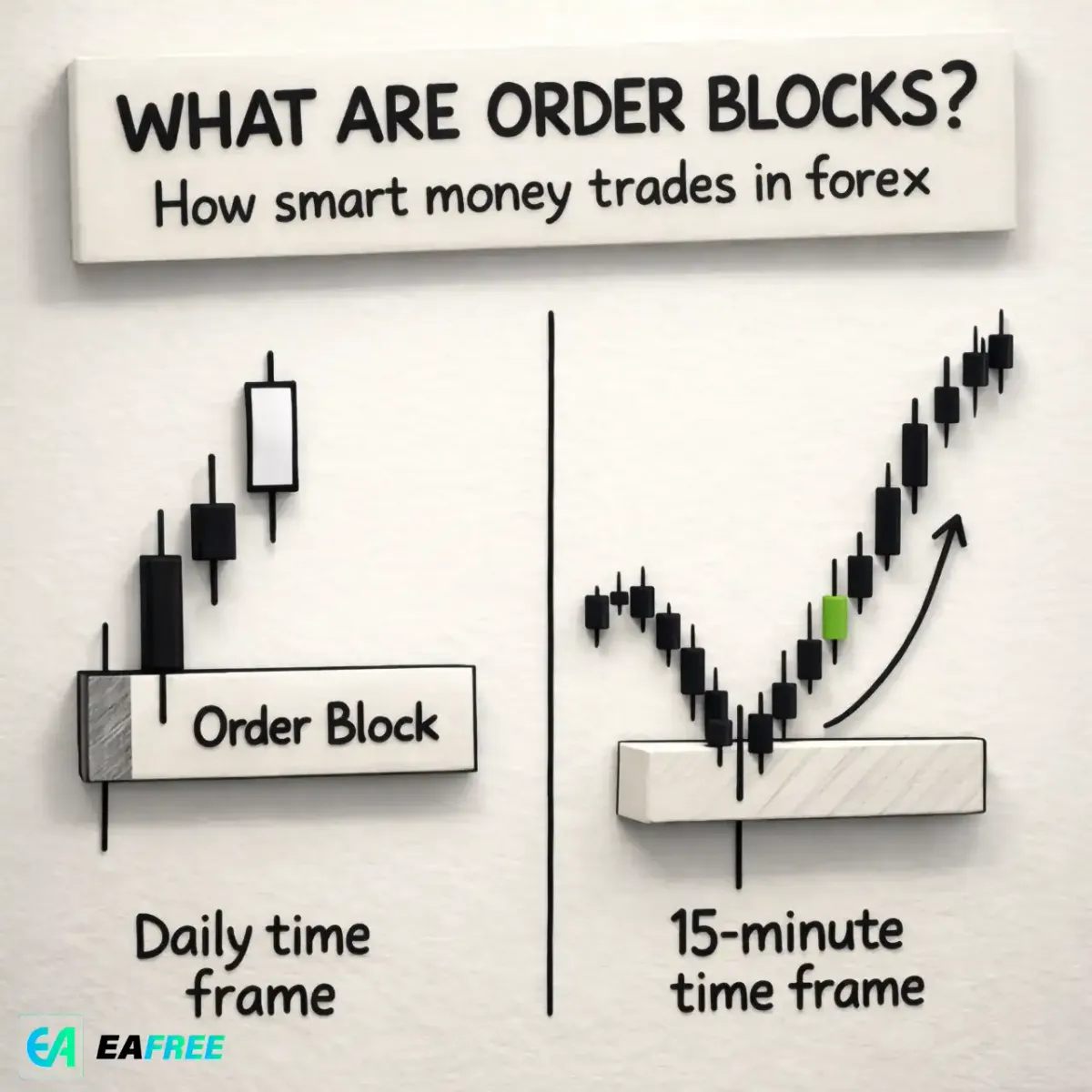
- A bullish order block is the last bearish candle before a strong upward move.
- A bearish order block is the last bullish candle before a strong downward move.
These zones often act as key support and resistance levels, where price is likely to react when revisited.
Why Are Order Blocks Important?
Order blocks matter because they reflect institutional activity, not just retail trading noise.
Here’s why traders pay attention to them:
//1. They Show Where Big Money Enters the Market
Retail traders move small amounts of capital. Institutions move millions or billions. When they enter the market, they leave behind “footprints”—and order blocks are one of those footprints.
//2. High Probability Trade Zones
Order blocks often become areas where price reacts strongly. This gives traders a higher probability of successful trades compared to random entries.
//3. Better Risk-to-Reward Ratios
Because order blocks are precise zones, they allow for tighter stop losses and larger potential profits.
Types of Order Blocks
Understanding the two main types is essential:
//Bullish Order Block
A bullish order block forms when:
- Price is moving downward
- A final bearish candle appears
- Then price makes a strong upward move
This indicates that institutions accumulated buy orders in that zone.
How to identify:
- Look for the last down candle before a strong rally
- Mark its range (body or full wick)
//Bearish Order Block
A bearish order block forms when:
- Price is moving upward
- A final bullish candle appears
- Then price drops sharply
This suggests institutions placed large sell orders there.
How to identify:
- Look for the last up candle before a strong drop
- Mark that area as a potential resistance zone
How Order Blocks Work in the Market
To understand order blocks, you need to think like institutions.
Institutions cannot enter all their positions at once—they would move the market too much. Instead, they:
- Accumulate positions gradually
- Push price in their desired direction
- Wait for price to return to fill remaining orders
This is why price often returns to an order block before continuing the trend.
How to Identify Valid Order Blocks
Not every candle qualifies as an order block. Here are key criteria to look for:
//1. Strong Impulsive Move
After the order block, price should move aggressively (large candles, little retracement).
//2. Break of Structure (BOS)
A valid order block often breaks a previous high or low, confirming a shift in market structure.
//3. Clean Zone
The order block should not be messy or heavily traded. Clean zones tend to work better.
//4. Imbalance or Fair Value Gap (FVG)
A gap or imbalance near the order block increases its reliability.
Step-by-Step: How to Trade Order Blocks
Here’s a simple process beginners can follow:
//Step 1: Identify Market Structure
Determine whether the market is trending up or down.
//Step 2: Locate the Order Block
Find the last opposing candle before a strong move.
//Step 3: Mark the Zone
Draw a rectangle around the candle (body or wick).
//Step 4: Wait for Price to Return
Patience is key. Let price come back to the order block.
//Step 5: Look for Confirmation
Use additional signals like:
- Candlestick patterns (pin bars, engulfing candles)
- Break of structure on lower timeframes
//Step 6: Enter the Trade
- Enter near the order block
- Place stop loss just beyond the zone
- Target previous highs/lows or liquidity zones
Common Mistakes Beginners Make
Even though order blocks are powerful, beginners often misuse them. Avoid these mistakes:
//1. Marking Every Candle as an Order Block
Not all candles are significant. Focus on those with strong moves.
//2. Ignoring Market Structure
Order blocks work best when aligned with the overall trend.
//3. Entering Too Early
Wait for confirmation instead of blindly placing trades.
//4. Overtrading
Quality matters more than quantity. Stick to high-probability setups.
Order Blocks vs Support and Resistance
You might be wondering: how are order blocks different from traditional support and resistance?
| Feature | Order Blocks | Support/Resistance |
|---|---|---|
| Based on | Institutional activity | Historical price levels |
| Precision | More precise zones | Often broader areas |
| Strategy | Smart money concepts | Classic technical analysis |
While both can be useful, order blocks provide deeper insight into why price moves, not just where it reacts.
Combining Order Blocks with Other Strategies
To improve your trading accuracy, combine order blocks with:
//1. Liquidity Zones
Identify where stop losses are likely placed.
//2. Trend Analysis
Trade in the direction of the higher timeframe trend.
//3. Fibonacci Retracement
Look for confluence between order blocks and key Fibonacci levels (e.g., 61.8%).
//4. Timeframes Alignment
Use higher timeframes (H4, Daily) for zones and lower timeframes (M15, M5) for entries.
Example Scenario
Let’s say EUR/USD is in an uptrend:
- Price pulls back
- Forms a bearish candle
- Then rallies strongly and breaks previous highs
That bearish candle becomes a bullish order block.
Later, price returns to that zone:
- You wait for confirmation (e.g., bullish engulfing)
- Enter a buy trade
- Place stop loss below the block
- Target higher highs
This is a classic order block setup.
Advantages of Using Order Blocks
- Helps identify institutional activity
- Improves entry precision
- Works across all timeframes
- Enhances risk management
- Can be combined with multiple strategies
Disadvantages to Be Aware Of
- Requires practice to identify correctly
- Can be subjective for beginners
- Not always 100% accurate (no strategy is)
- Needs patience and discipline
Tips for Beginners
If you’re just starting out, keep these tips in mind:
- Start on higher timeframes (H1, H4, Daily)
- Focus on clear, obvious setups
- Backtest your strategy before trading live
- Use a demo account to practice
- Keep a trading journal
Conclusion
Order blocks are a powerful concept that can transform the way you understand the Forex market. Instead of guessing where price might go, you begin to see the logic behind market movements—driven by institutional activity.
While it may take time to master, learning how to identify and trade order blocks can significantly improve your consistency and confidence as a trader.
Start simple, practice regularly, and combine order blocks with solid risk management—and you’ll be well on your way to becoming a more strategic Forex trader.
FAQ
//Are order blocks suitable for beginners?
Yes, but they require practice. Start with simple setups and higher timeframes.
//Do order blocks work in all markets?
Yes. They can be applied to Forex, stocks, crypto, and indices.
//Can I trade order blocks alone?
You can, but combining them with other tools improves accuracy.