

In the fast-paced world of Forex trading, timing is everything—but being glued to your screen 24/7 isn’t practical. That’s where pending orders come in. They allow traders to automate entries based on predefined price levels, helping you stay disciplined and capture opportunities even when you're away from the market.
Among the most commonly used pending orders are limit orders and stop orders. While they may sound similar, they serve very different purposes and are essential tools for executing strategic trades.
This guide will walk you through everything you need to know about pending orders, focusing specifically on the difference between limit and stop orders, how they work and how to use them effectively in Forex trading.
What Are Pending Orders in Forex Trading?
Pending orders are instructions you give your broker to open a trade at a specific price level in the future. Instead of entering the market instantly (like with a market order), you set conditions that must be met before your trade is executed.
This approach offers several advantages:
- You don’t need to monitor the market constantly
- You can plan trades more strategically
- It reduces emotional decision-making
- It ensures you enter trades at optimal price levels
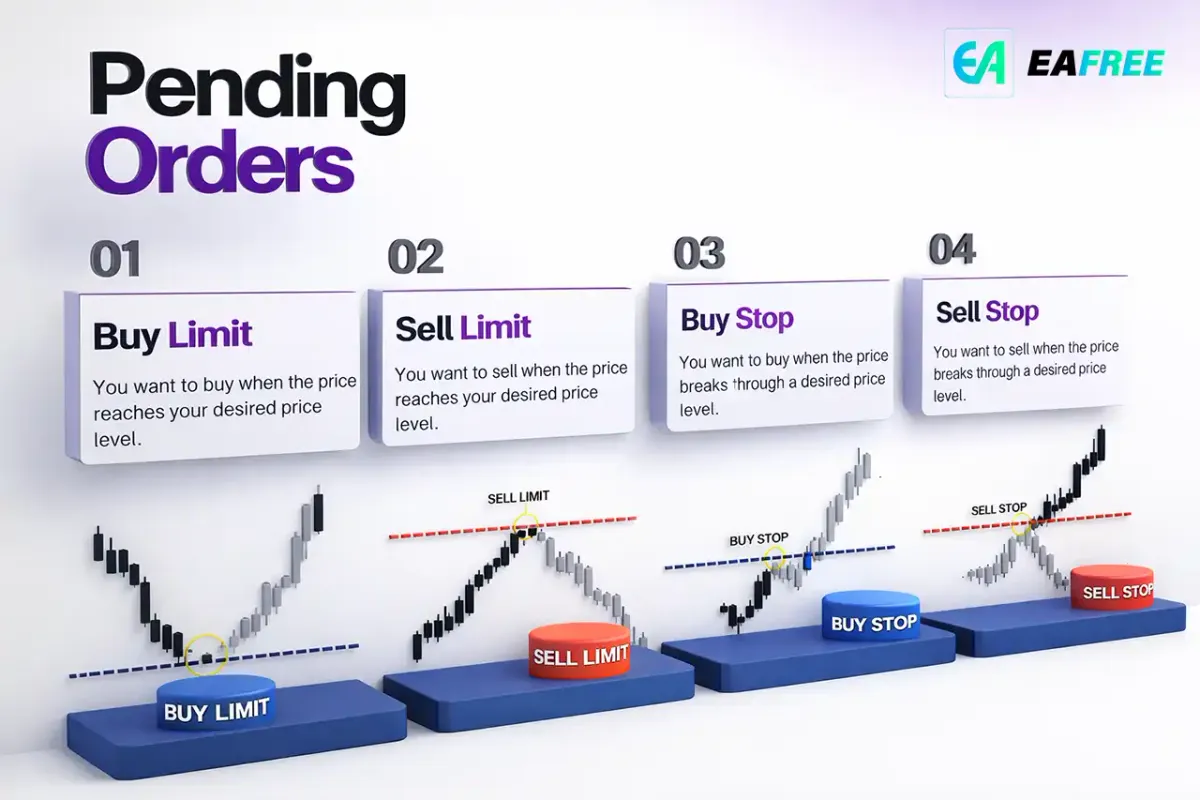
There are four main types of pending orders in Forex:
- Buy Limit
- Sell Limit
- Buy Stop
- Sell Stop
These can be grouped into two broader categories: limit orders and stop orders.
Understanding the distinction between these two is critical for improving your trading performance.
What Is a Limit Order?
A limit order is used when you expect the price to reverse after reaching a certain level. In simple terms, you are trying to buy low or sell high.
//Buy Limit Order
A buy limit order is placed below the current market price. Traders use it when they expect the price to drop to a certain level and then rise again.
Example:
If EUR/USD is currently trading at 1.1000, you might place a buy limit at 1.0950, expecting the price to bounce back up after reaching that level.
//Sell Limit Order
A sell limit order is placed above the current market price. It’s used when you expect the price to rise to a certain level and then reverse downward.
Example:
If EUR/USD is at 1.1000, you might place a sell limit at 1.1050, anticipating a downward reversal.
//Key Characteristics of Limit Orders
- Used for reversal strategies
- Placed at better prices than current market price
- Requires patience and accurate support/resistance analysis
- Often used in range-bound markets
Limit orders are ideal for traders who rely on technical analysis, particularly support and resistance levels.
What Is a Stop Order?
A stop order is used when you expect the price to continue moving in the same direction after breaking a certain level. This is often referred to as trading the breakout.
//Buy Stop Order
A buy stop order is placed above the current market price. It’s used when traders expect the price to continue rising after breaking a resistance level.
Example:
If EUR/USD is at 1.1000, you might place a buy stop at 1.1050, expecting a breakout and continued upward movement.
//Sell Stop Order
A sell stop order is placed below the current market price. It’s used when traders anticipate the price will continue falling after breaking support.
Example:
If EUR/USD is trading at 1.1000, placing a sell stop at 1.0950 allows you to enter the market once the price breaks lower.
//Key Characteristics of Stop Orders
- Used for momentum or breakout strategies
- Placed at worse prices than current market price
- Helps capture strong trends early
- Suitable for volatile market conditions
Stop orders are particularly popular among traders who follow trend continuation strategies.
Limit Orders vs Stop Orders: Key Differences
Understanding the difference between limit and stop orders is crucial for choosing the right strategy.
//Direction of Placement
- Limit orders are placed against the current price movement
- Stop orders are placed in the direction of the trend
//Trading Strategy
- Limit orders are used for reversals
- Stop orders are used for breakouts
//Price Expectation
- Limit: Expect price to reverse
- Stop: Expect price to continue
//Risk Profile
- Limit orders may offer better entry prices but can miss trades
- Stop orders ensure participation but may involve higher risk due to volatility
//Execution Logic
- Limit orders execute when the price becomes more favorable
- Stop orders execute when the price becomes less favorable
These differences highlight how each order type fits into different trading styles.
When Should You Use Limit Orders?
Limit orders are best used when the market is ranging or when you have identified strong support and resistance levels.
Situations where limit orders are effective include:
- Trading within a consolidation zone
- Entering at key Fibonacci retracement levels
- Buying near support and selling near resistance
- When you expect a pullback before continuation
For example, if the market has repeatedly bounced off a certain support level, placing a buy limit near that level can be a smart move.
However, one drawback is that the price may never reach your desired level, meaning you could miss potential trades.
When Should You Use Stop Orders?
Stop orders are most useful in trending markets or when you expect strong momentum.
They are ideal for:
- Breakout trading strategies
- News-driven volatility
- Entering trades during strong trends
- Avoiding early entries before confirmation
For instance, if a currency pair has been consolidating and is about to break out, a buy stop above resistance allows you to catch the move as it happens.
The downside is that false breakouts can trigger your order, leading to potential losses.
Combining Limit and Stop Orders in Trading
Experienced traders often use both limit and stop orders as part of a broader trading plan.
Here are some common combinations:
//Breakout and Retest Strategy
- Use a stop order to enter on breakout
- Use a limit order to enter on retest
This approach ensures you don’t miss the move while also giving you a chance to enter at a better price.
//Scaling Into Positions
- Place multiple limit orders at different levels
- Combine with stop orders for confirmation
This helps manage risk and improves average entry price.
//Risk Management Integration
Both order types can be combined with stop-loss and take-profit levels to create a complete trade setup.
Common Mistakes to Avoid
Even though pending orders are powerful tools, many traders misuse them.
Here are some mistakes to watch out for:
- Placing orders without proper analysis
- Setting orders too close to the current price (leading to premature execution)
- Ignoring market volatility
- Failing to use stop-loss protection
- Overcomplicating strategies with too many orders
The key is to keep your approach simple and aligned with your trading plan.
Practical Tips for Using Pending Orders Effectively
To get the most out of limit and stop orders, consider the following tips:
- Always base your orders on technical analysis
- Use higher timeframes to identify key levels
- Adjust for spreads and slippage
- Backtest your strategy before live trading
- Avoid placing orders during unpredictable market conditions unless part of your strategy
Consistency and discipline are more important than trying to catch every market move.
Why Understanding Pending Orders Matters
Mastering limit and stop orders is not just about mechanics—it’s about improving your overall trading psychology.
Pending orders help you:
- Remove emotional decision-making
- Stick to your trading plan
- Improve consistency
- Trade more efficiently
Instead of reacting to the market, you become proactive—planning trades in advance and letting the market come to you.
Conclusion
Limit and stop orders are foundational tools in Forex trading, each serving a distinct purpose. Limit orders help you enter trades at better prices during reversals, while stop orders allow you to capitalize on momentum and breakouts.
By understanding when and how to use each type, you can enhance your strategy, manage risk more effectively, and trade with greater confidence.
Whether you're a beginner or an experienced trader, incorporating pending orders into your trading plan is a step toward more structured and disciplined trading.