

Forex prop trading has become one of the most attractive opportunities for traders who want to access larger capital without risking significant personal funds. However, passing a prop firm challenge and maintaining long-term profitability requires more than just basic trading knowledge. Successful traders rely on disciplined strategies, risk management and emotional control to achieve consistent results.
In this guide, we will explore the top prop firm strategies for consistent Forex trading success, helping traders improve performance, reduce unnecessary losses, and increase the chances of passing funded account evaluations.
What is a Prop Firm in Forex Trading?
A proprietary trading firm, commonly known as a prop firm, provides traders with access to company capital in exchange for a share of the profits. Instead of trading only personal funds, traders can manage larger accounts and potentially generate higher returns.
Most Forex prop firms require traders to pass an evaluation process. This usually includes:
- Profit target requirements
- Maximum daily drawdown limits
- Overall risk restrictions
- Consistency rules
Because of these strict requirements, traders must adopt professional trading strategies focused on stability rather than aggressive profit chasing.

Why Consistency Matters in Prop Firm Trading
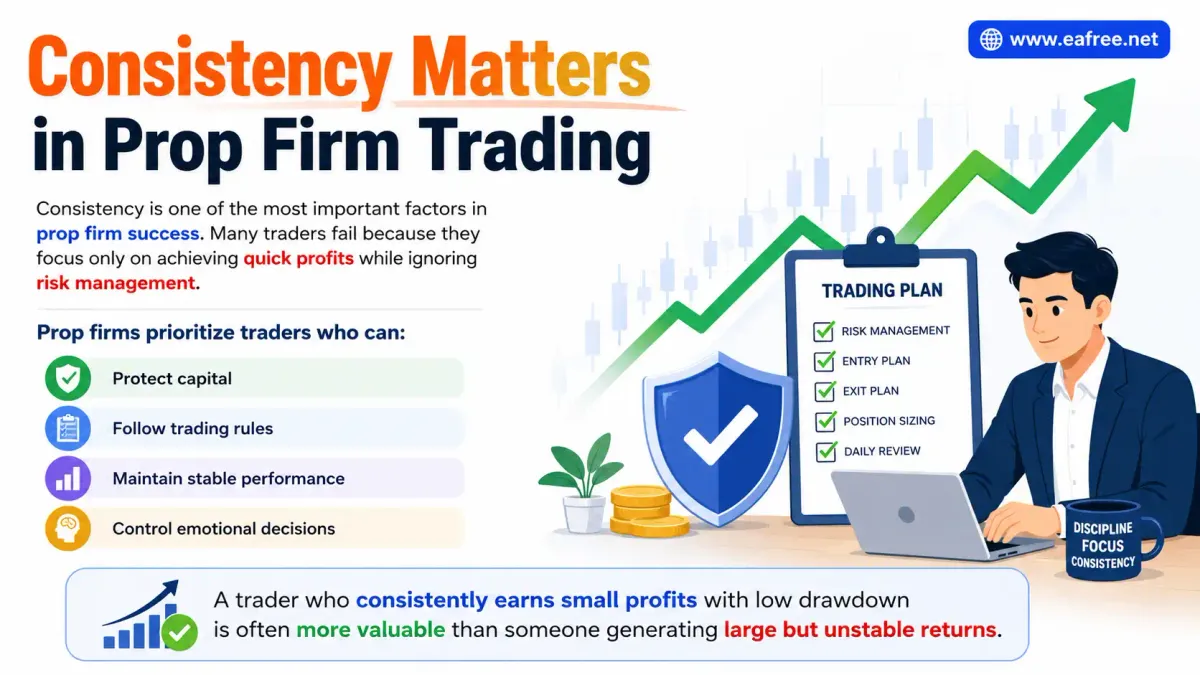
Consistency is one of the most important factors in prop firm success. Many traders fail because they focus only on achieving quick profits while ignoring risk management.
Prop firms prioritize traders who can:
- Protect capital.
- Follow trading rules.
- Maintain stable performance.
- Control emotional decisions.
A trader who consistently earns small profits with low drawdown is often more valuable than someone generating large but unstable returns.
Develop a Rule-Based Trading Plan
One of the best prop firm strategies is creating a detailed trading plan. A structured plan helps traders avoid impulsive decisions and maintain discipline under pressure.
Your trading plan should include:
| Trading Element | Description |
|---|---|
| Entry Rules | Conditions required before entering a trade |
| Exit Rules | Defined take-profit and stop-loss levels |
| Risk Per Trade | Usually 1% or less |
| Trading Sessions | Specific market hours to trade |
| Currency Pairs | Focus on familiar Forex pairs |
A rule-based approach improves consistency and makes performance easier to evaluate over time.
Focus on Risk Management First
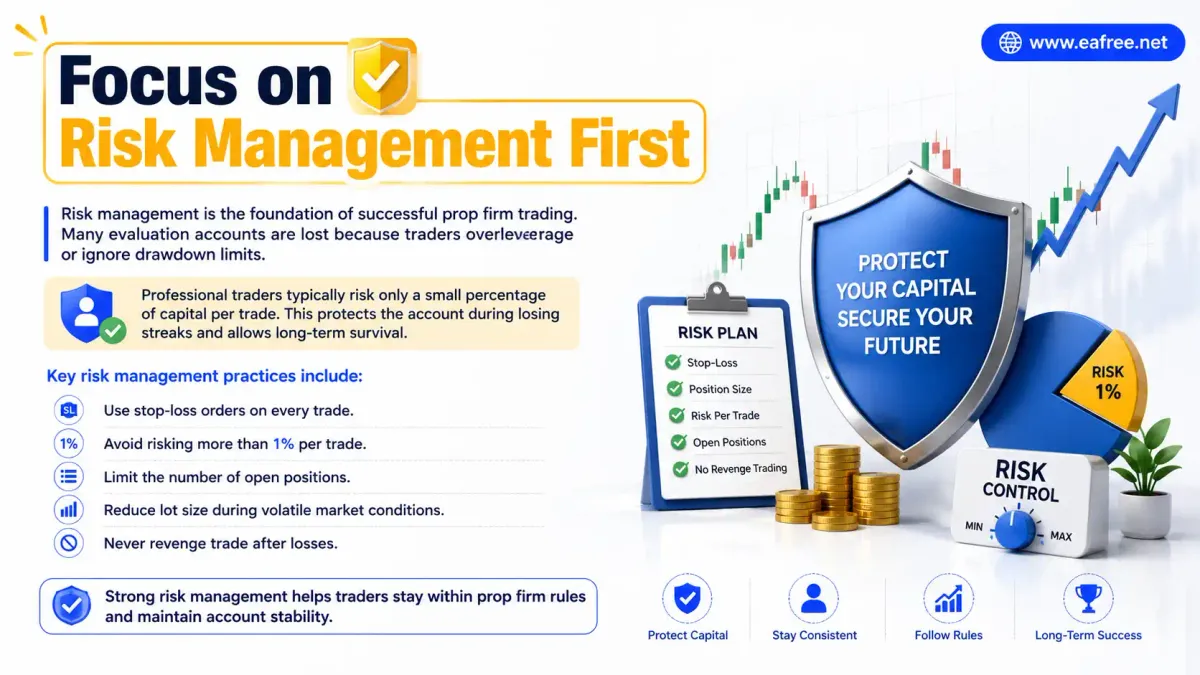
Risk management is the foundation of successful prop firm trading. Many evaluation accounts are lost because traders overleverage or ignore drawdown limits.
Professional traders typically risk only a small percentage of capital per trade. This protects the account during losing streaks and allows long-term survival.
Key risk management practices include:
- Use stop-loss orders on every trade.
- Avoid risking more than 1% per trade.
- Limit the number of open positions.
- Reduce lot size during volatile market conditions.
- Never revenge trade after losses.
Strong risk management helps traders stay within prop firm rules and maintain account stability.
Master One Trading Strategy
Many traders fail because they constantly switch between strategies. Instead of chasing every market opportunity, successful prop firm traders focus on mastering one proven system.
Popular Forex trading strategies include:
//Trend Following
This strategy focuses on trading in the direction of the overall market trend. Traders often use moving averages, trendlines, and price action confirmation.
//Breakout Trading
Breakout traders enter positions when price moves beyond key support or resistance levels with strong momentum.
//Scalping
Scalping involves taking multiple small trades throughout the day. This strategy requires fast execution and strict discipline.
//Swing Trading
Swing traders hold positions for several days to capture medium-term market movements.
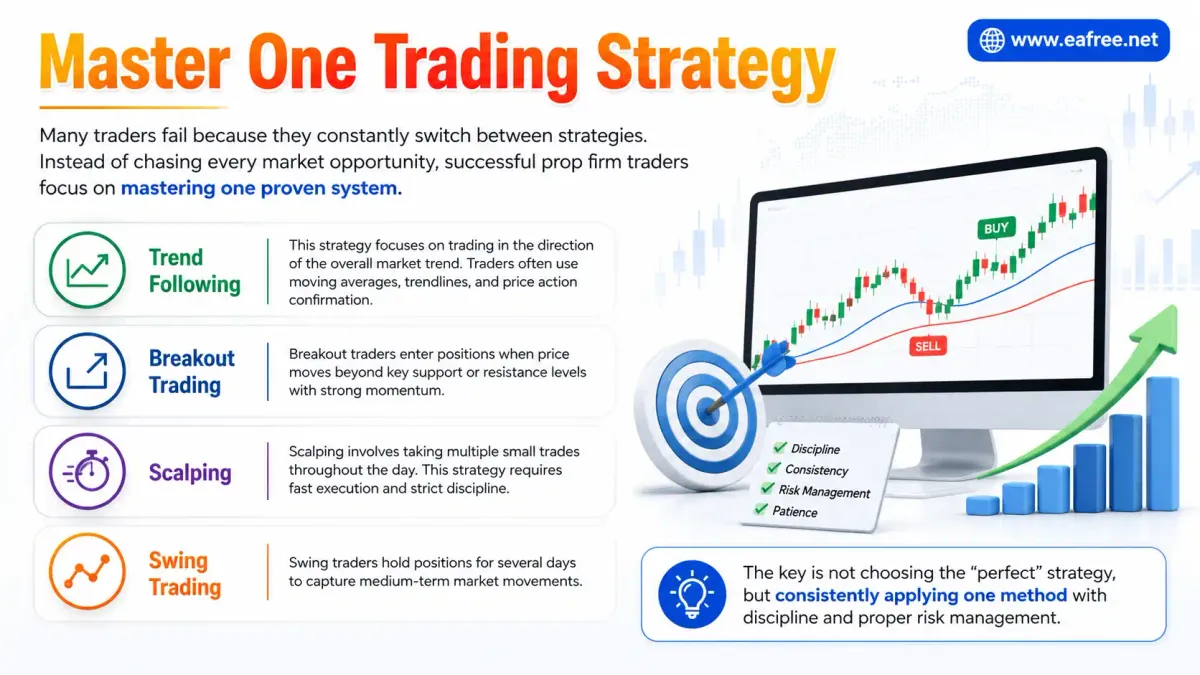
The key is not choosing the “perfect” strategy, but consistently applying one method with discipline and proper risk management.
Use High-Probability Trade Setups
Prop firms reward consistency, not excessive trading frequency. Taking fewer but higher-quality trades often produces better long-term results.
Before entering a trade, confirm:
- Market trend direction
- Support and resistance zones
- Risk-to-reward ratio
- News event impact
- Technical confirmation signals
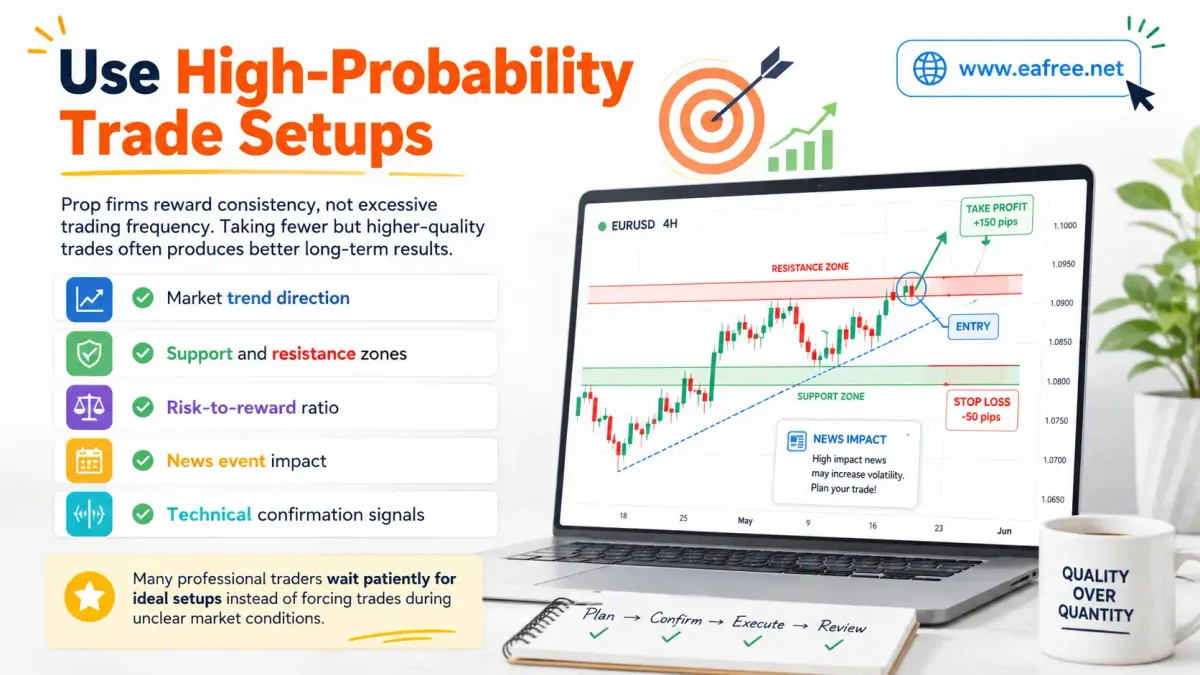
Many professional traders wait patiently for ideal setups instead of forcing trades during unclear market conditions.
Control Emotions While Trading
Emotional discipline separates successful traders from losing traders. Fear, greed, and frustration often lead to poor decision-making.
Common emotional mistakes include:
- Overtrading after losses
- Moving stop losses
- Closing winning trades too early
- Increasing lot sizes impulsively
To improve emotional control:
- Follow a predefined trading plan
- Take breaks after losing trades
- Keep realistic profit expectations
- Maintain a trading journal
Trading psychology is especially important in prop firm evaluations because emotional mistakes can quickly violate drawdown rules.
Keep a Detailed Trading Journal
A trading journal allows traders to analyze strengths and weaknesses objectively. Recording every trade helps identify patterns that improve future performance.
Your journal should track:
| Journal Category | Example |
|---|---|
| Entry Price | 1.1050 |
| Exit Price | 1.1100 |
| Trade Setup | Breakout |
| Risk-to-Reward | 1:2 |
| Emotional State | Calm / Emotional |
| Result | Win or Loss |
Reviewing this data regularly helps traders refine strategies and improve consistency.
Avoid Overtrading
Overtrading is one of the biggest reasons traders fail prop firm challenges. Many traders believe more trades equal more profits, but this often leads to unnecessary losses.
Instead of trading constantly:
- Focus only on high-quality setups
- Set a maximum daily trade limit
- Stop trading after reaching loss limits
- Avoid trading during emotional periods
Patience is often more profitable than excessive activity in Forex trading.
Adapt to Market Conditions
Forex markets constantly change due to economic news, geopolitical events, and market sentiment. Successful prop traders understand how to adapt without abandoning their core strategy.
For example:
- Use smaller positions during high volatility
- Avoid trading before major news releases
- Focus on trending strategies during strong trends
- Reduce trading frequency in sideways markets
Flexibility combined with discipline helps traders survive different market environments.
Conclusion
Achieving consistent Forex trading success with a prop firm requires discipline, patience, and strong risk management. Traders who focus on protecting capital, following structured strategies, and maintaining emotional control are more likely to pass evaluations and sustain funded accounts long term.
Rather than chasing unrealistic profits, successful prop traders prioritize consistency and steady performance. By mastering one strategy, managing risk carefully, and maintaining a professional mindset, traders can significantly improve their chances of long-term success in the competitive world of Forex prop trading.
FAQs
❓ What is the best strategy for passing a Forex prop firm challenge?
The best strategy is one that focuses on consistency, proper risk management, and disciplined execution rather than aggressive profit targets.
❓ How much risk should I take per trade in prop firm trading?
Most professional traders recommend risking no more than 1% of account capital per trade.
❓ Why do most traders fail prop firm evaluations?
Common reasons include overtrading, poor risk management, emotional trading, and violating drawdown limits.
❓ Is scalping good for prop firm trading?
Scalping can work well if the trader has strict discipline, fast execution, and a clear risk management plan.
❓ How important is psychology in Forex prop trading?
Trading psychology is extremely important because emotional mistakes can quickly lead to rule violations and account losses.