
Introduction
The foreign exchange (Forex) market is one of the most dynamic and liquid financial markets in the world. With trillions of dollars traded daily, traders constantly seek reliable tools to analyze price movements and make informed decisions. Among these tools, Forex indicators stand out as essential components of technical analysis.
Whether you're a beginner or an experienced trader, understanding how Forex indicators work—and how to use them effectively—can significantly improve your trading performance. In this ultimate guide, we’ll explore the different types of Forex indicators, proven strategies, and practical tips to help you trade smarter.
What are Forex Indicators?
Forex indicators are mathematical calculations based on historical price data, volume or open interest. They are typically displayed on charts and help traders identify trends, momentum, volatility, and potential entry or exit points.
Indicators simplify complex market data into visual signals, making it easier to interpret price behavior.
//Why Are Forex Indicators Important?
- Help identify market trends
- Provide entry and exit signals
- Improve decision-making accuracy
- Reduce emotional trading
- Support risk management strategies
Types of Forex Indicators
Forex indicators can be broadly categorized into four main types:
//1. Trend Indicators
Trend indicators help traders determine the direction of the market—whether it’s moving upward, downward or sideways.
Popular Trend Indicators:
How They Work:
Trend indicators smooth out price data to highlight the underlying direction. For example, if the price is above a moving average, it typically indicates an uptrend.
//2. Momentum Indicators
Momentum indicators measure the speed and strength of price movements. They are useful for identifying overbought or oversold conditions.
Popular Momentum Indicators:
How They Work:
These indicators oscillate between fixed levels (e.g., 0–100), helping traders determine when a currency pair may reverse direction.
//3. Volatility Indicators
Volatility indicators show how much the price is fluctuating over time. High volatility often signals potential trading opportunities.
Popular Volatility Indicators:
How They Work:
They expand and contract based on market activity. For instance, Bollinger Bands widen during high volatility and narrow during low volatility.
//4. Volume Indicators
Although Forex is a decentralized market, volume indicators still provide insights using tick volume.
Popular Volume Indicators:
How They Work:
They track the number of price movements (ticks) to estimate buying and selling pressure.
Best Forex Indicators for Beginners
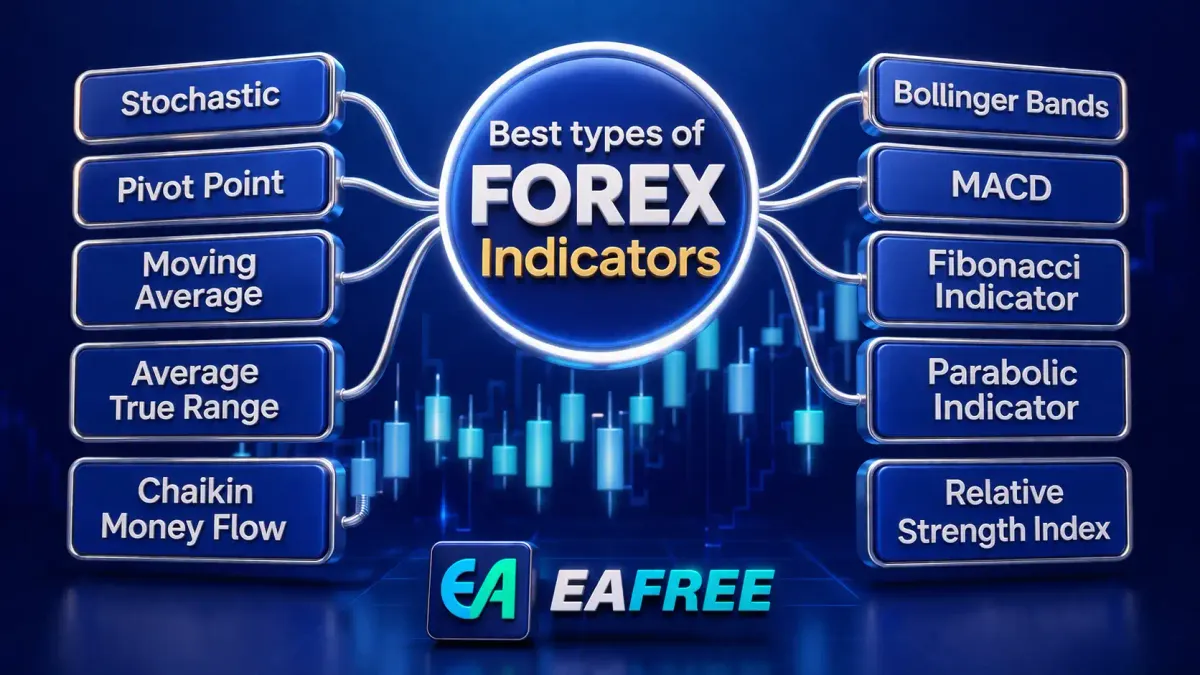
If you're new to Forex trading, it's best to start with simple and widely used indicators:
//Moving Average (MA)
- Easy to understand
- Helps identify trends
- Works well in trending markets
//Relative Strength Index (RSI)
- Identifies overbought/oversold levels
- Great for spotting reversals
//Bollinger Bands
- Combines trend and volatility
- Helps detect breakout opportunities
Advanced Forex Indicators for Experienced Traders
For traders with more experience, combining multiple indicators can provide deeper insights:
//MACD (Moving Average Convergence Divergence)
- Combines trend and momentum
- Generates crossover signals
//Fibonacci Retracement
- Identifies potential support and resistance levels
- Useful for predicting retracement zones
//Ichimoku Cloud
- Comprehensive indicator
- Shows trend, momentum, and support/resistance in one system
Forex Indicator Strategies
Using indicators alone is not enough—you need a strategy. Below are some proven approaches:
//1. Trend Following Strategy
Indicators Used:
- Moving Average
- MACD
How It Works:
- Enter a trade in the direction of the trend
- Buy when price is above MA and MACD is bullish
- Sell when price is below MA and MACD is bearish
//2. Reversal Strategy
Indicators Used:
- RSI
- Stochastic Oscillator
How It Works:
- Look for overbought (>70) or oversold (<30) conditions
- Enter trades when the market shows signs of reversal
//3. Breakout Strategy
Indicators Used:
- Bollinger Bands
- ATR
How It Works:
- Identify periods of low volatility
- Enter trades when price breaks out of a range
//4. Scalping Strategy
Indicators Used:
- EMA (Exponential Moving Average)
- RSI
How It Works:
- Focus on small price movements
- Enter and exit trades quickly
- Requires tight risk management

Common Mistakes When Using Forex Indicators
Even though indicators are powerful, misuse can lead to losses.
//Overloading Charts
Using too many indicators can create confusion and conflicting signals.
//Ignoring Market Context
Indicators should not be used in isolation. Always consider:
- Economic news
- Market sentiment
- Support and resistance levels
//Lagging Nature of Indicators
Most indicators are based on past data, meaning they can lag behind price movements.
//Blindly Following Signals
Always confirm signals with multiple indicators or price action.
Tips for Using Forex Indicators Effectively
//1. Combine Indicators Wisely
Use indicators from different categories (trend + momentum) for better accuracy.
//2. Backtest Your Strategy
Test your indicator strategy on historical data before using it in live trading.
//3. Keep It Simple
Start with 2–3 indicators instead of cluttering your chart.
//4. Use Multiple Timeframes
Analyze the market across different timeframes for stronger confirmation.
//5. Practice Risk Management
Always use stop-loss and take-profit levels to protect your capital.
How to Choose the Right Forex Indicator
Choosing the right indicator depends on your trading style:
| Trading Style | Recommended Indicators |
|---|---|
| Scalping | EMA, RSI |
| Day Trading | MACD, Bollinger Bands |
| Swing Trading | Fibonacci, RSI |
| Position Trading | Moving Average, Ichimoku |
Combining Forex Indicators with Price Action
While indicators are helpful, combining them with price action can significantly enhance your trading accuracy.
Key Price Action Tools:
- Support and resistance
- Candlestick patterns
- Trendlines
Example:
If RSI shows oversold conditions and price hits a strong support level, the probability of a reversal increases.
Final Thoughts
Forex indicators are powerful tools that can greatly enhance your trading strategy when used correctly. However, they are not magic solutions. Success in Forex trading comes from a combination of:
- Proper knowledge
- Consistent strategy
- Discipline
- Risk management
Start with a few reliable indicators, understand how they work, and gradually refine your approach. Over time, you’ll develop a system that suits your trading style and helps you navigate the Forex market with confidence.