
Introduction to Weighted Moving Average (WMA)
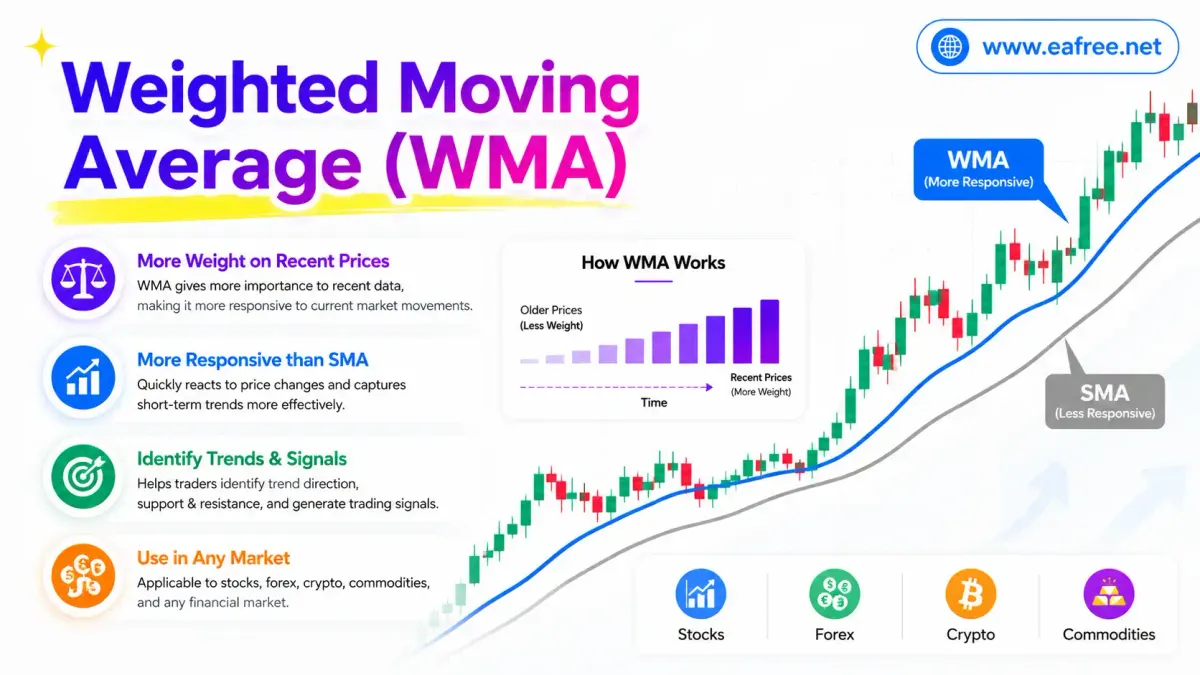
The Weighted Moving Average (WMA) is one of the most popular technical indicators used in financial markets. Traders use it to identify trends, smooth price fluctuations, and generate trading signals with greater responsiveness than traditional moving averages.
Unlike the Simple Moving Average (SMA), which gives equal importance to all price points, the WMA assigns more weight to recent prices. This makes it more sensitive to current market movements and useful for short-term and medium-term trading strategies.
Whether you trade stocks, forex, crypto, or commodities, understanding how the Weighted Moving Average works can help improve your market analysis and decision-making.
How Weighted Moving Average Works
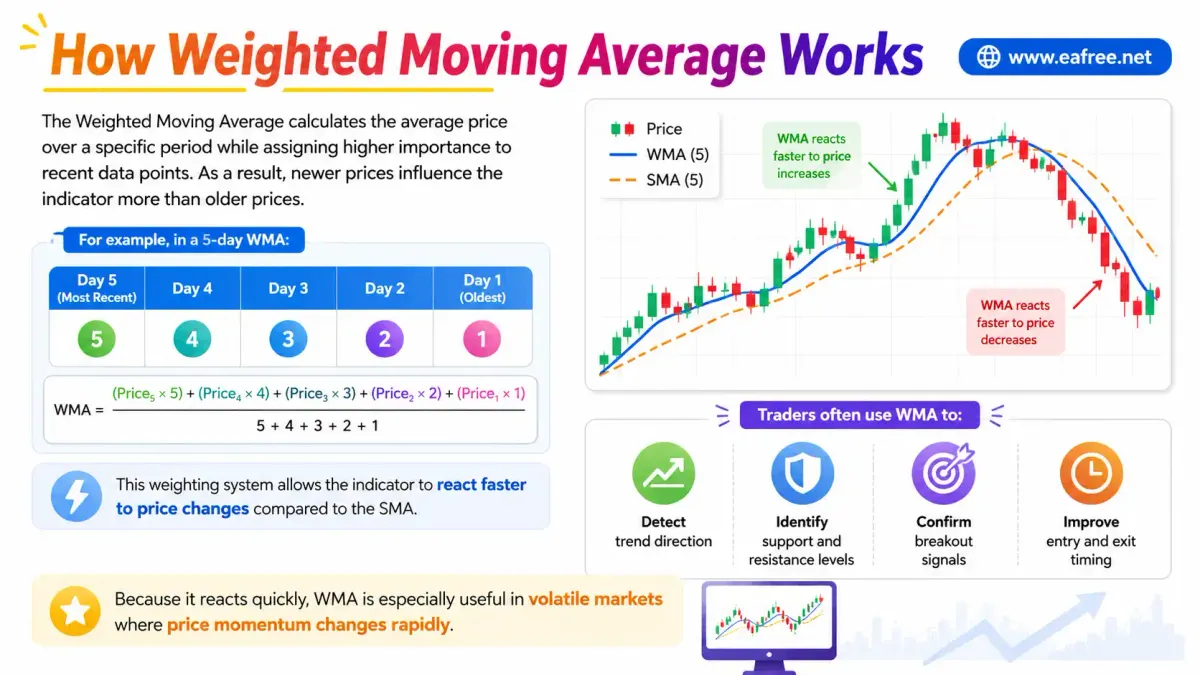
The Weighted Moving Average calculates the average price over a specific period while assigning higher importance to recent data points. As a result, newer prices influence the indicator more than older prices.
For example, in a 5-day WMA:
- The most recent price may receive a weight of 5
- The previous day gets a weight of 4
- Earlier days receive progressively lower weights
This weighting system allows the indicator to react faster to price changes compared to the SMA.
Traders often use WMA to:
- Detect trend direction
- Identify support and resistance levels
- Confirm breakout signals
- Improve entry and exit timing
Because it reacts quickly, WMA is especially useful in volatile markets where price momentum changes rapidly.
WMA Formula Explained
The Weighted Moving Average uses a mathematical formula that multiplies each price by a specific weight before calculating the average.
Here’s a simple example using a 5-day WMA:
| Day | Closing Price | Weight | Price × Weight |
|---|---|---|---|
| 1 | 100 | 1 | 100 |
| 2 | 102 | 2 | 204 |
| 3 | 104 | 3 | 312 |
| 4 | 106 | 4 | 424 |
| 5 | 108 | 5 | 540 |
Total Weighted Value = 1580
Total Weight = 15
The final WMA calculation becomes:
1580 ÷ 15 = 105.33
This result reflects recent price action more accurately than a standard average.
WMA vs SMA vs EMA
Many traders compare WMA with other moving averages like SMA and EMA. Each indicator has unique characteristics and serves different purposes.
| Indicator | Speed | Weight Distribution | Best For |
|---|---|---|---|
| SMA | Slow | Equal weights | Long-term trends |
| EMA | Fast | Exponential weighting | Momentum trading |
| WMA | Medium-Fast | Linear weighting | Accurate trend analysis |
The SMA is smoother but slower to react. EMA reacts very quickly because it prioritizes recent prices exponentially. WMA sits between the two, offering a balance between smoothness and responsiveness.
Traders who want better sensitivity without excessive market noise often prefer the WMA.
Benefits of Using WMA in Trading
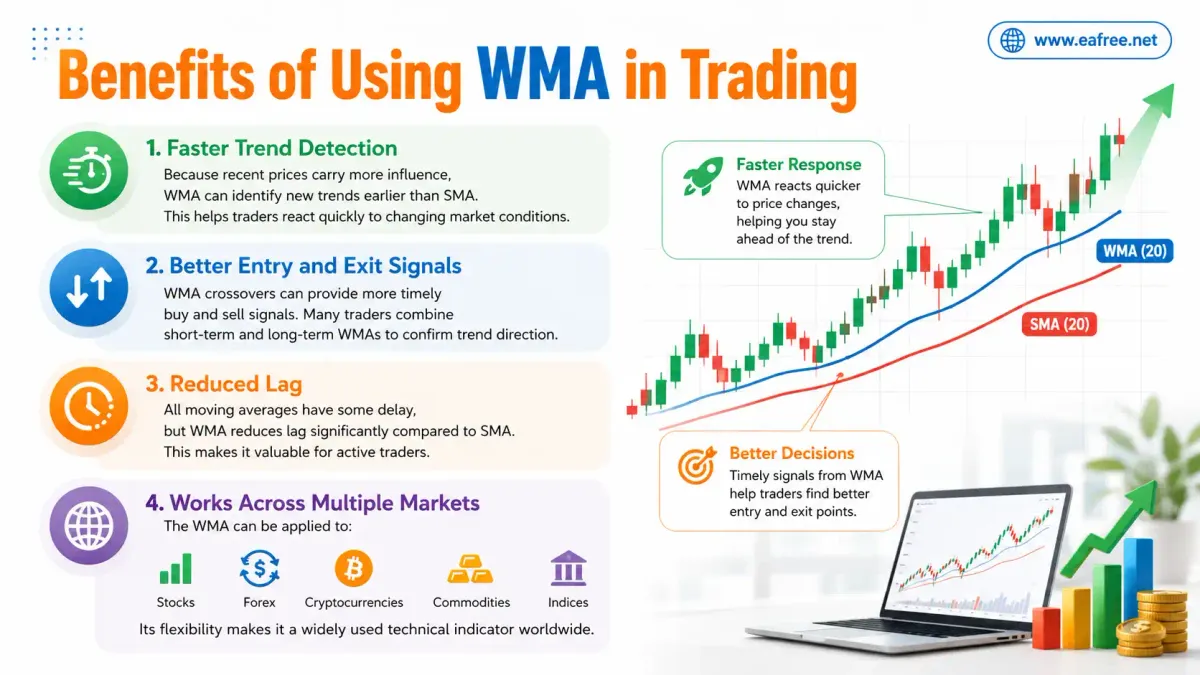
The Weighted Moving Average provides several advantages for traders and investors.
//Faster Trend Detection
Because recent prices carry more influence, WMA can identify new trends earlier than SMA. This helps traders react quickly to changing market conditions.
//Better Entry and Exit Signals
WMA crossovers can provide more timely buy and sell signals. Many traders combine short-term and long-term WMAs to confirm trend direction.
//Reduced Lag
All moving averages have some delay, but WMA reduces lag significantly compared to SMA. This makes it valuable for active traders.
//Works Across Multiple Markets
The WMA can be applied to:
- Stocks
- Forex
- Cryptocurrencies
- Commodities
- Indices
Its flexibility makes it a widely used technical indicator worldwide.
Limitations of WMA
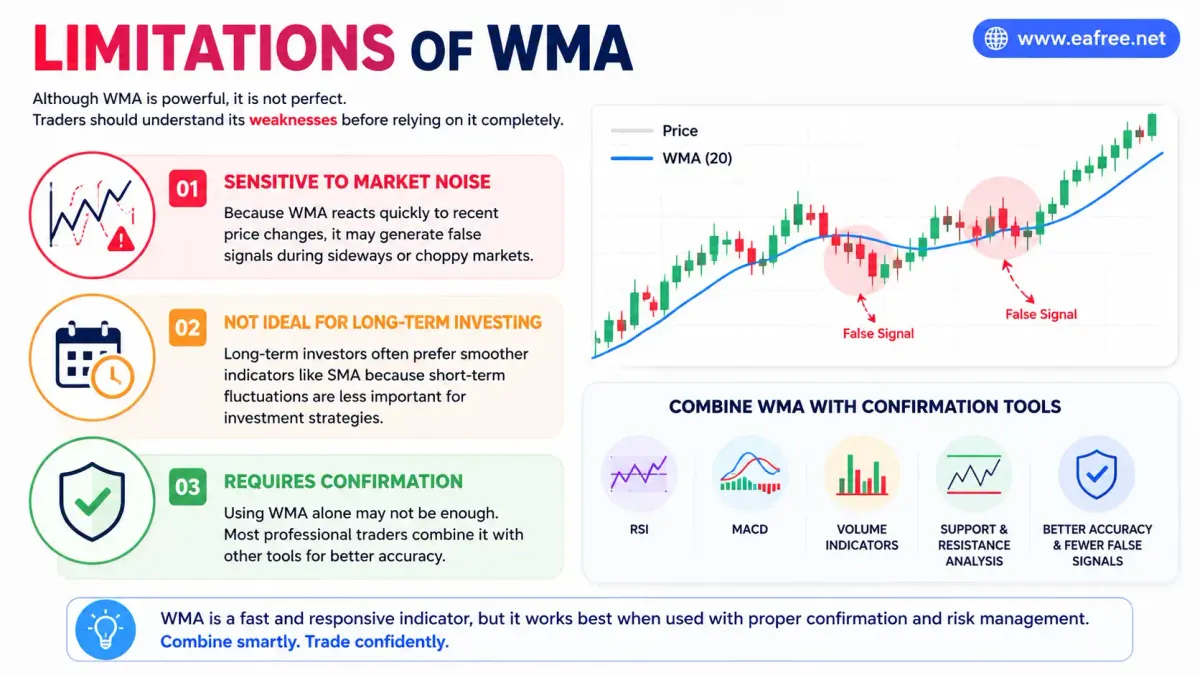
Although WMA is powerful, it is not perfect. Traders should understand its weaknesses before relying on it completely.
//Sensitive to Market Noise
Because WMA reacts quickly to recent price changes, it may generate false signals during sideways or choppy markets.
//Not Ideal for Long-Term Investing
Long-term investors often prefer smoother indicators like SMA because short-term fluctuations are less important for investment strategies.
//Requires Confirmation
Using WMA alone may not be enough. Most professional traders combine it with:
- RSI
- MACD
- Volume indicators
- Support and resistance analysis
This helps reduce false signals and improve trading accuracy.
Best Trading Strategies Using WMA
The Weighted Moving Average can be integrated into several effective trading strategies.
//WMA Crossover Strategy
This strategy uses two WMAs with different periods.
Example:
- 10-period WMA
- 30-period WMA
A bullish signal occurs when the shorter WMA crosses above the longer WMA. A bearish signal appears when it crosses below.
//Dynamic Support and Resistance
In trending markets, the WMA often acts as dynamic support or resistance. Traders watch for price rebounds around the indicator.
//Trend Confirmation
When price stays consistently above the WMA, it usually indicates bullish momentum. When price remains below it, bearish pressure is stronger.
These strategies become more effective when combined with proper risk management.
Tips for Using WMA Effectively
To maximize the effectiveness of the Weighted Moving Average, traders should follow several best practices.
//Choose the Right Period
Shorter WMAs react faster but produce more noise. Longer WMAs provide smoother signals but react more slowly.
Popular settings include:
| Trading Style | Recommended WMA |
|---|---|
| Scalping | 5–10 periods |
| Day Trading | 10–20 periods |
| Swing Trading | 20–50 periods |
| Long-Term Trading | 50–100 periods |
//Combine with Other Indicators
No single indicator guarantees success. Combining WMA with momentum indicators and price action analysis improves reliability.
//Avoid Overtrading
Frequent crossover signals can tempt traders to enter too many positions. Patience and confirmation are essential.
Conclusion
The Weighted Moving Average (WMA) is a valuable technical indicator for traders seeking smarter and faster trend analysis. By assigning greater importance to recent prices, WMA responds more quickly to market changes than traditional moving averages.
It is especially useful for identifying trends, confirming momentum and improving entry and exit timing. However, like any trading tool, it works best when combined with other indicators and solid risk management techniques.
Whether you are a beginner or an experienced trader, mastering the WMA can help you make more informed trading decisions and improve your overall market strategy.
FAQs
❓ What is the main purpose of the Weighted Moving Average (WMA)?
The main purpose of WMA is to identify market trends while giving greater importance to recent prices for faster analysis.
❓ Is WMA better than SMA?
WMA reacts faster to price movements than SMA, making it more suitable for active trading. However, SMA may be better for long-term trend analysis.
❓ Which markets can use WMA?
WMA works well in stocks, forex, cryptocurrencies, commodities, and indices.
❓ What is the best WMA setting for day trading?
Many day traders use 10-period or 20-period WMAs because they provide a good balance between speed and reliability.
❓ Can beginners use the Weighted Moving Average?
Yes. WMA is beginner-friendly and easy to understand, especially when combined with basic trend analysis techniques.