
What Is Weighted Moving Average (WMA)?
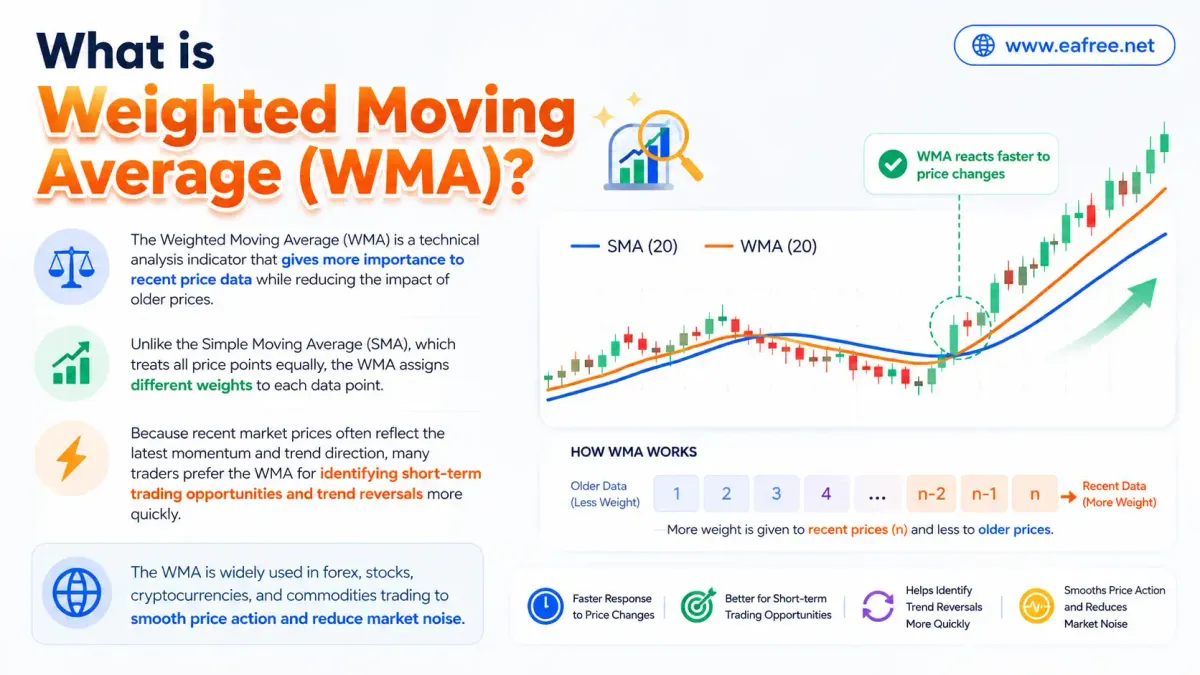
The Weighted Moving Average (WMA) is a technical analysis indicator that gives more importance to recent price data while reducing the impact of older prices. Unlike the Simple Moving Average (SMA), which treats all price points equally, the WMA assigns different weights to each data point.
Because recent market prices often reflect the latest momentum and trend direction, many traders prefer the WMA for identifying short-term trading opportunities and trend reversals more quickly.
The WMA is widely used in forex, stocks, cryptocurrencies, and commodities trading to smooth price action and reduce market noise.
How Does Weighted Moving Average Work?
A Weighted Moving Average calculates the average price over a selected period while applying larger weights to the newest prices.
For example, in a 5-day WMA:
- The most recent price gets a weight of 5
- The second most recent gets 4
- The third gets 3
- And so on
This weighting system makes the WMA react faster to price changes compared to other moving averages.
Example of WMA Weight Distribution:
| Price Period | Weight |
|---|---|
| Most Recent Day | 5 |
| Day 2 | 4 |
| Day 3 | 3 |
| Day 4 | 2 |
| Oldest Day | 1 |
This structure helps traders spot market direction earlier.
The WMA formula multiplies each closing price by its assigned weight, then divides the result by the sum of all weights.
Step-by-Step Calculation:
Assume the following 5-day closing prices:
| Day | Closing Price | Weight | Price × Weight |
|---|---|---|---|
| 1 | 100 | 1 | 100 |
| 2 | 102 | 2 | 204 |
| 3 | 104 | 3 | 312 |
| 4 | 106 | 4 | 424 |
| 5 | 108 | 5 | 540 |
Total Calculation:
- Sum of weighted prices = 1580
- Sum of weights = 15
So:
1580 ÷ 15 = 105.33
The 5-day Weighted Moving Average is 105.33.
WMA vs SMA vs EMA
Many traders compare the Weighted Moving Average with the Simple Moving Average (SMA) and Exponential Moving Average (EMA).
| Feature | WMA | SMA | EMA |
|---|---|---|---|
| Sensitivity to Price | High | Low | Very High |
| Weight on Recent Prices | Moderate | Equal | Strong |
| Lagging Effect | Lower | Higher | Lowest |
| Best for | Short-term trends | Long-term trends | Fast-moving markets |
Which One Is Better?
There is no universally “best” moving average. The right choice depends on your trading style:
- WMA works well for swing trading and short-term analysis.
- SMA is useful for identifying broader market trends.
- EMA is preferred by aggressive traders seeking quick signals.
Uses of Weighted Moving Average in Trading
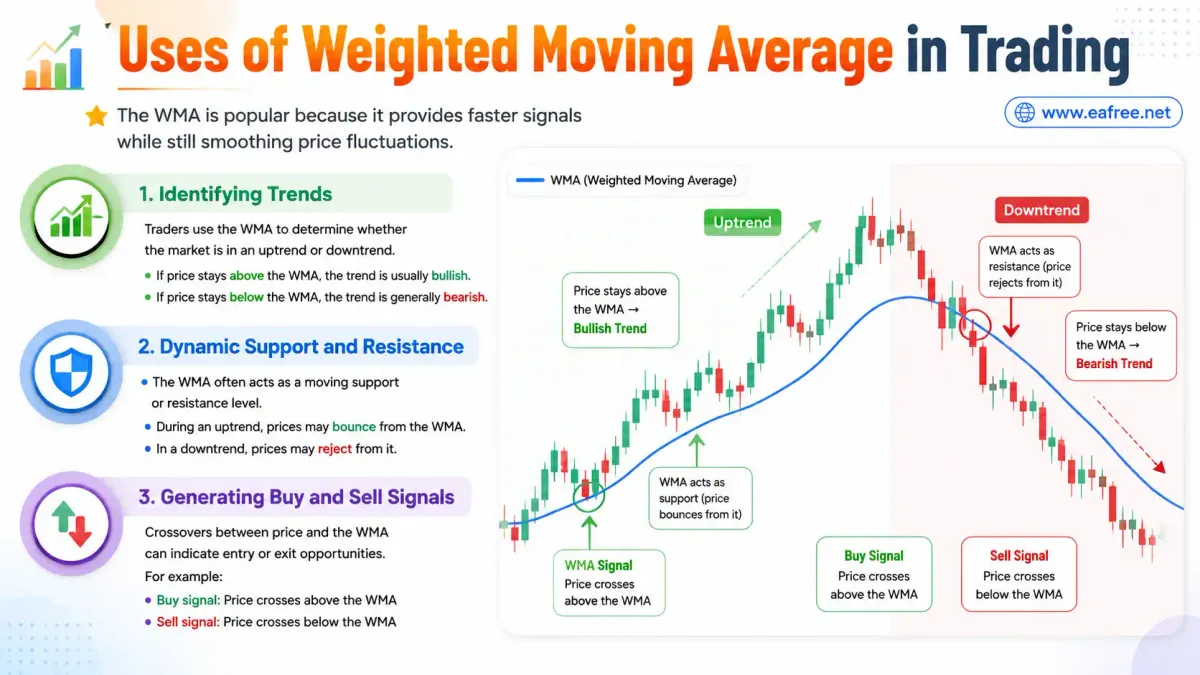
The WMA is popular because it provides faster signals while still smoothing price fluctuations.
//Identifying Trends
Traders use the WMA to determine whether the market is in an uptrend or downtrend.
- If price stays above the WMA, the trend is usually bullish.
- If price stays below the WMA, the trend is generally bearish.
//Dynamic Support and Resistance
The WMA often acts as a moving support or resistance level.
During an uptrend, prices may bounce from the WMA. In a downtrend, prices may reject from it.
//Generating Buy and Sell Signals
Crossovers between price and the WMA can indicate entry or exit opportunities.
For example:
- Buy signal: Price crosses above the WMA
- Sell signal: Price crosses below the WMA
Best Weighted Moving Average Trading Strategies
Using the WMA alone can be effective, but combining it with other indicators improves accuracy.
//1. WMA Crossover Strategy
This strategy uses two WMAs with different periods.
Example Setup:
| Fast WMA | Slow WMA |
|---|---|
| 10-period WMA | 30-period WMA |
Trading Rules:
- Buy when the fast WMA crosses above the slow WMA
- Sell when the fast WMA crosses below the slow WMA
This strategy helps traders catch emerging trends early.
//2. WMA with RSI Strategy
Combining the WMA with the Relative Strength Index (RSI) helps confirm momentum.
Example:
- Buy when price is above the WMA and RSI rises above 50
- Sell when price is below the WMA and RSI falls below 50
This method reduces false signals in sideways markets.
//3. WMA Pullback Strategy
In trending markets, traders wait for the price to retrace toward the WMA before entering.
Why It Works:
The WMA acts as a dynamic support or resistance zone, allowing traders to enter with better risk-to-reward ratios.
This strategy is commonly used in forex and crypto trading.
Advantages of Weighted Moving Average
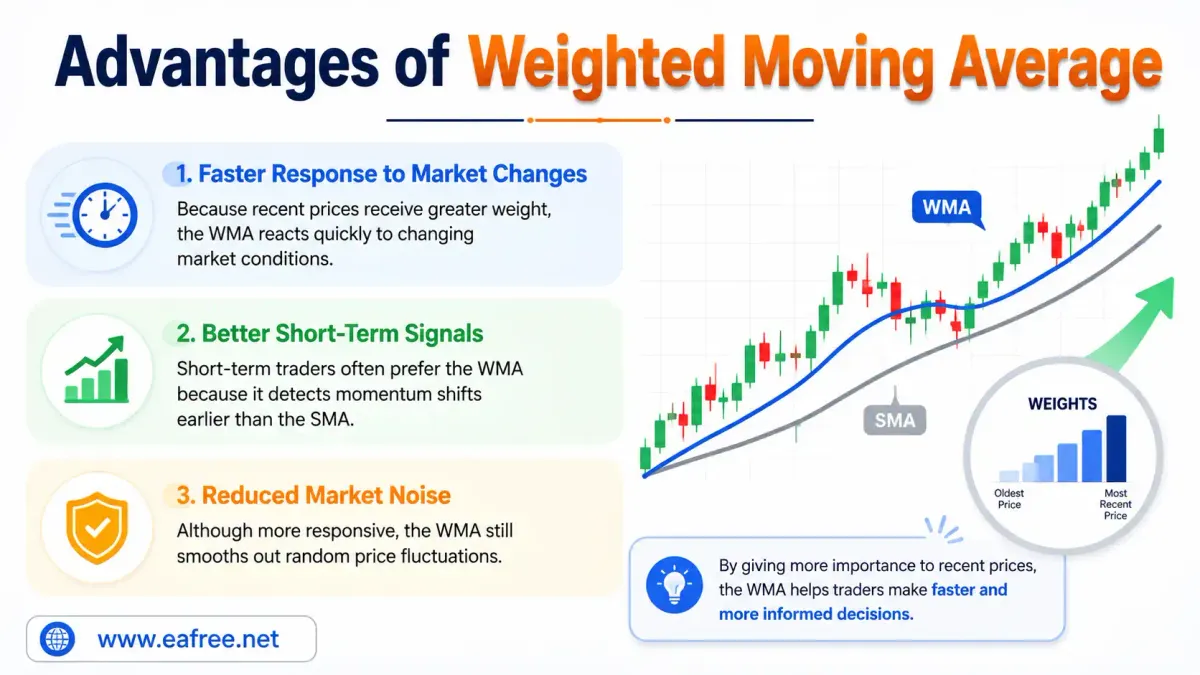
The WMA offers several benefits for technical traders.
- Faster Response to Market Changes: Because recent prices receive greater weight, the WMA reacts quickly to changing market conditions.
- Better Short-Term Signals: Short-term traders often prefer the WMA because it detects momentum shifts earlier than the SMA.
- Reduced Market Noise: Although more responsive, the WMA still smooths out random price fluctuations.
Limitations of Weighted Moving Average
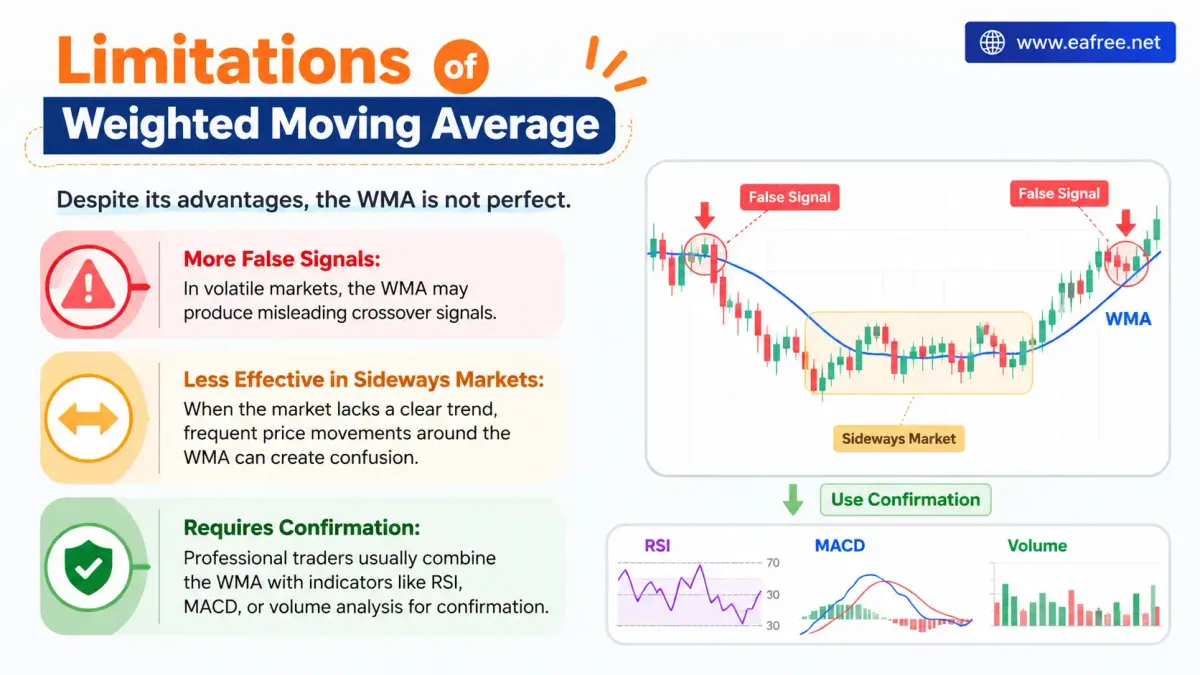
Despite its advantages, the WMA is not perfect.
- More False Signals: In volatile markets, the WMA may produce misleading crossover signals.
- Less Effective in Sideways Markets: When the market lacks a clear trend, frequent price movements around the WMA can create confusion.
- Requires Confirmation: Professional traders usually combine the WMA with indicators like RSI, MACD, or volume analysis for confirmation.
Tips for Using WMA Effectively
To improve trading performance with the Weighted Moving Average:
- Use higher timeframes to avoid market noise.
- Combine WMA with momentum indicators.
- Backtest your strategy before live trading.
- Avoid relying on a single indicator.
- Adjust WMA periods based on market conditions.
Risk management remains essential regardless of the indicator used.
Conclusion
The Weighted Moving Average (WMA) is a powerful technical analysis tool that prioritizes recent price data to provide faster trading signals. Compared to the SMA, the WMA reacts more quickly to trend changes while still smoothing market fluctuations.
Traders use the WMA for trend identification, crossover strategies, support and resistance analysis and momentum confirmation. While it offers advantages in fast-moving markets, it works best when combined with other technical indicators and proper risk management.
Whether you trade stocks, forex, or cryptocurrencies, understanding how the Weighted Moving Average works can help improve your market analysis and trading decisions.
FAQs
❓ What is the difference between WMA and SMA?
The WMA gives more importance to recent prices, while the SMA treats all prices equally.
❓ Is Weighted Moving Average better than EMA?
Not necessarily. The EMA reacts faster, while the WMA offers a balanced approach between sensitivity and smoothing.
❓ Which WMA setting is best for trading?
Popular settings include 9, 14, 20, and 50 periods, depending on your trading strategy and timeframe.
❓ Can beginners use the Weighted Moving Average?
Yes. The WMA is beginner-friendly and widely used in technical analysis.
❓ Does WMA work for crypto trading?
Yes. Many crypto traders use the WMA to identify short-term trends and momentum shifts in volatile markets.